
1. what are the difference between skimming and scaning as reading practices ?
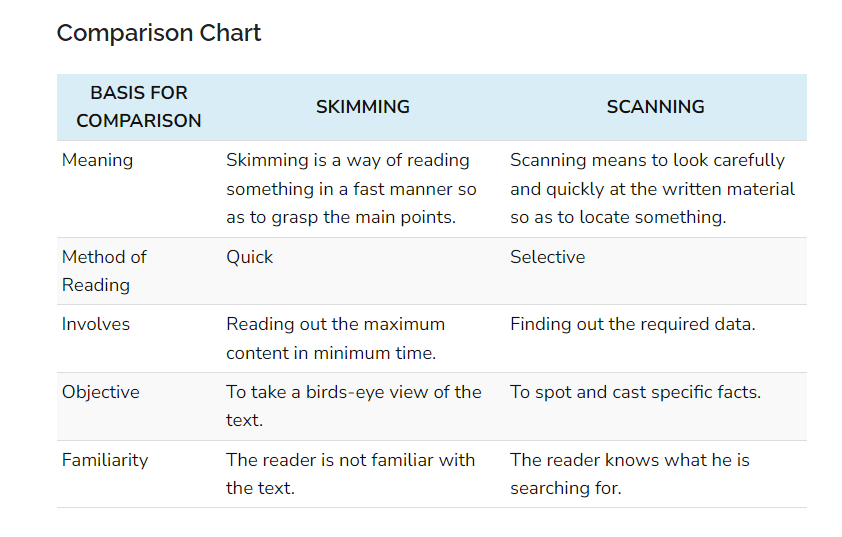
2. briefly discuss the steps involved in s1/s2 a passage ?
Steps in Skimming a Passage
- Read the title as it is the shortest possible summary of the content1.
- Read the introduction or lead-in paragraph1.
- Read the first paragraph completely1.
- If there are subheadings, read each one, looking for relationships among them1.
- Read the first sentence of each remaining paragraph1.
- Read the first and last sentences of paragraphs, first and last paragraphs of major sections, and introductions and summaries of chapters2.
- Focus on the introduction, chapter summaries, bold words, and text features2.
Steps in Scanning a Passage
- Search for keywords, one at a time, while jumping around the passage3.
- Scan through the passages rapidly until you find the keyword you search for3.
- Read the surrounding material carefully, decide if you’ve found what you need3.
- Look for answers to only one question at a time4.
- Choose your keywords from the question itself4.
- Let your eyes float rapidly down the page until you find the word or phrase you want4.
- When your eye catches one of your keywords, read the surrounding material carefully4.
3. what kind of queries can be made by the interviewer to his/her prospective employer ?
Here are some queries that an interviewer can make to their prospective employer:
- Company’s Vision: What is the company’s vision for the next five years?
- Role Specifics: Can you provide more details about the day-to-day responsibilities of this job?
- Performance Evaluation: How is success defined and measured in this role?
- Company Culture: Can you describe the company’s culture?
- Professional Development: What opportunities for professional development does the company offer?
- Team Dynamics: Can you tell me about the team I’ll be working with?
- Challenges: What are some challenges that will face the person filling this position?
- Next Steps: What are the next steps in the interview process?
4. how do you highlight your strenth and weekness in a job interview ?
Strengths:
- Identify: Start by identifying your key strengths that are relevant to the job role. These could be technical skills, soft skills, or experiences.
- Examples: Provide specific examples of how you’ve used these strengths in your past roles to achieve results. This helps to substantiate your claims.
- Link: Connect your strengths to the job requirements. Explain how your strengths will help you excel in the role you’re interviewing for.
Weaknesses:
- Choose: Choose a real weakness, but make sure it’s not a key requirement for the job.
- Contextualize: Put the weakness in context. It’s important to acknowledge it without making it a major part of your character.
- Improve: Discuss the steps you’re taking to improve this weakness. This shows self-awareness and a willingness to develop
5. which expression can be used to express agreement/disagreement with an opinion in a GD ?
Agreement:
- “I completely agree with you.”
- “That’s a valid point.”
- “I was about to say the same thing.”
- “You took the words right out of my mouth.”
- “I couldn’t agree more.”
Disagreement:
- “I see your point, but I think…”
- “I understand where you’re coming from, however…”
- “That’s an interesting perspective, but have you considered…”
- “I respectfully disagree because…”
- “I have a different perspective on this.”
6. state how would you introduce yourself in a confernece
Good morning/afternoon/evening everyone,
My name is [Your Name], and I am currently [Your Job Title] at [Your Company/Organization]. I specialize in [Your Area of Expertise], and I have been working in this field for [Number of Years/Months in the Field].
I am here today to [Your Purpose for Attending the Conference]. I am looking forward to learning from all of you and sharing my insights on [Topic You're Interested in or Speaking About].
Thank you for having me at this conference.
7. elaborate on how to irritate your audiences to ask questions at a presentation
- Pause and Ask for Questions: After explaining a complex point, pause and ask if anyone has questions. This gives your audience time to digest the information and think of questions.
- Encourage Participation: Make your presentation interactive. Ask rhetorical questions or opinions on the topic at hand. This can stimulate thought and encourage your audience to ask questions.
- Create a Safe Environment: Make it clear that all questions are welcome and there are no “stupid” questions. This can make your audience feel more comfortable about asking questions.
- Be Enthusiastic: Show your passion for the topic. Enthusiasm is contagious and can encourage your audience to get more involved
8.how would you tackle durations in a GD ?
- Structured Approach: Develop a structured approach to express your thoughts effectively within the given time frame. Start by outlining your key points and then present them systematically.
- Avoid Repetition: Avoid going off-topic or repeating what others have already said. This ensures that the discussion stays focused and time is not wasted on redundant points.
- Assign Roles: Assign roles to each person in the group such as a facilitator, note-taker, or timekeeper. The timekeeper can ensure that the discussion stays within the allotted time.
- Summarize and Document: Make sure to summarize the discussion and document any decisions that were made This helps in keeping track of the discussion’s progress and ensures that no important points are missed out due to time constraints
9.explain the importance of active listening in a GD
Active listening plays a crucial role in group discussions (GDs) for several reasons:
1. **Demonstrates Respect and Engagement:**
Active listening shows respect for the speaker and indicates that you value their perspective. In a GD, it's essential to convey your engagement with the topic and other participants. Active listening through attentive body language, such as making eye contact, nodding, and avoiding distractions, demonstrates your commitment to the discussion.
2. **Facilitates Understanding:**
Group discussions often involve diverse viewpoints and ideas. Active listening enables you to comprehend the arguments, opinions, and perspectives presented by others fully. By understanding the different viewpoints, you can engage more meaningfully in the discussion, contribute relevant points, and build upon others' ideas.
3. **Promotes Collaboration and Constructive Dialogue:**
Active listening fosters an environment conducive to collaboration and constructive dialogue. When participants feel heard and understood, they are more likely to engage in respectful exchanges, leading to the exploration of ideas, solutions, and consensus-building. It encourages a free flow of information and encourages participants to build upon each other's contributions.
4. **Reduces Miscommunication and Conflicts:**
Miscommunication is common in group settings, leading to misunderstandings and conflicts. Active listening helps mitigate these issues by clarifying information, asking relevant questions, and seeking clarification when needed. By actively listening to others' viewpoints, you can avoid making assumptions or misinterpreting their statements, thereby reducing the likelihood of conflicts arising.
5. **Enhances Problem-Solving and Decision-Making:**
In GDs focused on problem-solving or decision-making, active listening is essential for gathering relevant information, evaluating options, and reaching informed conclusions. By actively listening to all perspectives, participants can consider a broader range of ideas, weigh their merits, and collectively arrive at more effective solutions or decisions.
6. **Builds Rapport and Trust:**
Active listening builds rapport and trust among participants by fostering an inclusive and respectful environment. When individuals feel listened to and understood, they are more likely to trust one another, collaborate effectively, and work towards common goals. This positive interpersonal dynamic enhances the overall quality of the discussion and strengthens relationships among participants.
In summary, active listening is fundamental in group discussions as it promotes respectful engagement, facilitates understanding and collaboration, reduces conflicts, enhances problem-solving, and builds rapport and trust among participants. By actively listening to others' viewpoints, you can contribute meaningfully to the discussion and help achieve its objectives effectively.