
Partielo | Créer ta fiche de révision en ligne rapidement

Tight Junctions (Occluding Junctions)


Intercellular junctions are classified into three types:

  1. Impermeable junctions (tight junctions)
  2. Adhesion junctions (macula adherens, zonula adherens, and hemidesmosomes)
  3. Communication junctions (gap junctions)


Occluding Junctions – Tight Junctions

Tight junctions function to join cells together and create an impermeable barrier, preventing materials from passing through the intercellular space in epithelial layers. These junctions are essential for maintaining selective permeability in epithelial tissues.

  • Location: Tight junctions are situated between adjacent plasma membranes and are found at the most apical (top) part of epithelial cells. They encircle the entire circumference of the cell in a belt-like formation.
  • Structure: In electron microscopy (EM), the membranes of adjoining cells come very close to each other, with their outer leaflets fusing. The fusion sites contain key molecular components of tight junctions, such as occludins and claudins.
  • Occurrence: Tight junctions are found in epithelial cell sheets, vascular endothelial cells, and other cell types, including Schwann cells and oligodendrocytes.
  • Appearance: Under transmission electron microscopy, tight junctions appear as a series of closely apposed membranes, often referred to as ‘kissing points,’ between adjacent cells.
  • Function: Tight junctions act as a barrier to the paracellular transport of ions, solutes, water, and even cells. They help divide the apical and basolateral regions of plasma membranes, preventing the free movement of substances between cells.
  • Significance: These junctions are crucial for maintaining distinct tissue compartments within the body, there by helping to maintain homeostasis. Disruption of tight junctions can contribute to various diseases, including inflammatory bowel disease, infections, cancer, vasogenic edema, and blood-borne metastasis.
  • Barrier Function: Tight junctions are also important in restricting the delivery of drugs to underlying tissues, as seen in the blood-brain barrier (BBB).


Tight Junctions (Occluding Junctions)


Intercellular junctions are classified into three types:

  1. Impermeable junctions (tight junctions)
  2. Adhesion junctions (macula adherens, zonula adherens, and hemidesmosomes)
  3. Communication junctions (gap junctions)


Occluding Junctions – Tight Junctions

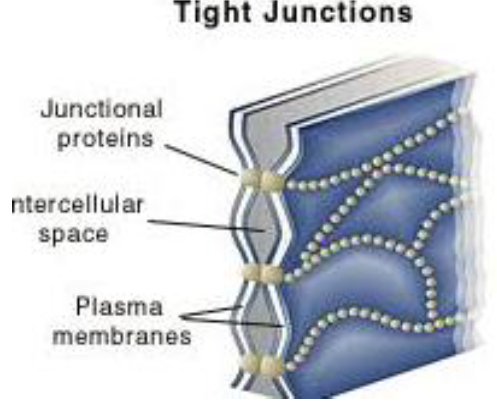
Tight junctions function to join cells together and create an impermeable barrier, preventing materials from passing through the intercellular space in epithelial layers. These junctions are essential for maintaining selective permeability in epithelial tissues.

  • Location: Tight junctions are situated between adjacent plasma membranes and are found at the most apical (top) part of epithelial cells. They encircle the entire circumference of the cell in a belt-like formation.
  • Structure: In electron microscopy (EM), the membranes of adjoining cells come very close to each other, with their outer leaflets fusing. The fusion sites contain key molecular components of tight junctions, such as occludins and claudins.
  • Occurrence: Tight junctions are found in epithelial cell sheets, vascular endothelial cells, and other cell types, including Schwann cells and oligodendrocytes.
  • Appearance: Under transmission electron microscopy, tight junctions appear as a series of closely apposed membranes, often referred to as ‘kissing points,’ between adjacent cells.
  • Function: Tight junctions act as a barrier to the paracellular transport of ions, solutes, water, and even cells. They help divide the apical and basolateral regions of plasma membranes, preventing the free movement of substances between cells.
  • Significance: These junctions are crucial for maintaining distinct tissue compartments within the body, there by helping to maintain homeostasis. Disruption of tight junctions can contribute to various diseases, including inflammatory bowel disease, infections, cancer, vasogenic edema, and blood-borne metastasis.
  • Barrier Function: Tight junctions are also important in restricting the delivery of drugs to underlying tissues, as seen in the blood-brain barrier (BBB).