Partielo | Créer ta fiche de révision en ligne rapidement
Post-Bac
2

Session n°5

Human resource

Compensation and Benefits

What is reward ?

Introduction

Rewards are essential to the attraction, motivation and retention of employees and the achievement of an organization's goals, objectives and priorities

• Effective reward management must strike a balance between:

‒ The reward capabilities and goals of the organization

‒ The potentially diverse set of reward needs and preferences of its workforce

‒ Several other external and internal forces in the organization's business environment when designing and administering a total reward framework


Defining reward management

• Common to all definitions:

‒ reflects how rewards are designed and administered,

‒ the notion that reward management is critical to attracting, retaining, and motivating employees to achieve desirable outcomes


The conceptualization of reward

=> Economic school:

  • as medium of exchange and have utility, cost and control connotations
  • as a cost of production provided to employees in exchange for the economic value they add to the firm

=> Psychology school:

  • as motivational mechanisms

=> Management theories:

  • the efficacy of a reward is affected by various situational and contextual forces

II - Types and systems of compensation

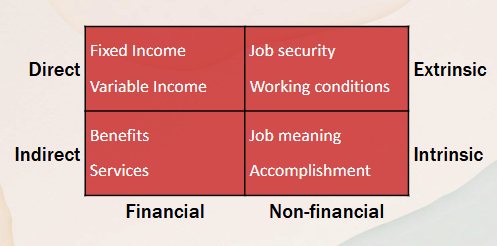
Types of rewards

The strategic role of rewards

• Rewards can play a strategic role in cultivating change and achieving

performance objectives, including:

‒fostering a strong performance culture

‒promoting corporate entrepreneurship

‒supporting innovation

‒encouraging safety

‒building high-performance work systems

• Rewards signal to employees the behaviours and performance outcomes that are valued by an organization (e.g. PFP)

III - Paying for performance

Paying for performance (PFP) (rémunération à a performance), based on the notion that its incentive value motivates desired behaviour and reinforces effort HOWEVER, need a clear, measurable and objective link between the reward and the desired performance outcome


Paying for performance

While performance-based pay aims to incentivize productivity, it can lead to several unintended and harmful consequences:

  • Encourages risk-taking and short-term focus, often at the expense of long-term goals.
  • Discourages important but unrewarded behaviors, such as teamwork or ethical practices.
  • Attracts risk-prone individuals, potentially shifting company culture in an undesirable direction.
  • May cause toxic workplace dynamics, including bullying and unhealthy competition.
  • Can foster unethical practices, as seen in the 2008 financial crisis (e.g., selling sub-prime mortgages).


Measuring PFP

Considerations:

‒PFP is based on individual, group/unit, or organizational performance?

‒the emphasis of PFP is results - (e.g. production outputs, sales revenue targets) or behaviour- riented (e.g. customer ratings)?

‒PFP is based on objective measures (e.g. piece-rate) or subjective measures (e.g. supervisor ratings)?

‒the pay and performance criteria are clearly specified and communicated to employees in advance?


Linking pay to performance

Reward managers must address questions, such as:

o Is pay linked only to intended performance outcomes or other outcomes?

o What proportion of the pay is variable or contingent on performance?

o What are the pay differences between high and low performers?

o Is PFP applied to all types of jobs or only certain groups of employees?

Pay transparency exists on a spectrum from full secrecy to complete openness. It requires thoughtful consideration of:

  • The level of disclosure: partial (e.g., pay ranges by role) vs. full (e.g., individual salaries by name).
  • What information is shared: pay distribution processes, performance criteria, salary increases, etc.
  • Privacy concerns: balancing transparency with confidentiality and employee privacy.
Post-Bac
2

Session n°5

Human resource

Compensation and Benefits

What is reward ?

Introduction

Rewards are essential to the attraction, motivation and retention of employees and the achievement of an organization's goals, objectives and priorities

• Effective reward management must strike a balance between:

‒ The reward capabilities and goals of the organization

‒ The potentially diverse set of reward needs and preferences of its workforce

‒ Several other external and internal forces in the organization's business environment when designing and administering a total reward framework


Defining reward management

• Common to all definitions:

‒ reflects how rewards are designed and administered,

‒ the notion that reward management is critical to attracting, retaining, and motivating employees to achieve desirable outcomes


The conceptualization of reward

=> Economic school:

  • as medium of exchange and have utility, cost and control connotations
  • as a cost of production provided to employees in exchange for the economic value they add to the firm

=> Psychology school:

  • as motivational mechanisms

=> Management theories:

  • the efficacy of a reward is affected by various situational and contextual forces
II - Types and systems of compensation

Types of rewards

The strategic role of rewards

• Rewards can play a strategic role in cultivating change and achieving

performance objectives, including:

‒fostering a strong performance culture

‒promoting corporate entrepreneurship

‒supporting innovation

‒encouraging safety

‒building high-performance work systems

• Rewards signal to employees the behaviours and performance outcomes that are valued by an organization (e.g. PFP)

III - Paying for performance

Paying for performance (PFP) (rémunération à a performance), based on the notion that its incentive value motivates desired behaviour and reinforces effort HOWEVER, need a clear, measurable and objective link between the reward and the desired performance outcome


Paying for performance

While performance-based pay aims to incentivize productivity, it can lead to several unintended and harmful consequences:

  • Encourages risk-taking and short-term focus, often at the expense of long-term goals.
  • Discourages important but unrewarded behaviors, such as teamwork or ethical practices.
  • Attracts risk-prone individuals, potentially shifting company culture in an undesirable direction.
  • May cause toxic workplace dynamics, including bullying and unhealthy competition.
  • Can foster unethical practices, as seen in the 2008 financial crisis (e.g., selling sub-prime mortgages).


Measuring PFP

Considerations:

‒PFP is based on individual, group/unit, or organizational performance?

‒the emphasis of PFP is results - (e.g. production outputs, sales revenue targets) or behaviour- riented (e.g. customer ratings)?

‒PFP is based on objective measures (e.g. piece-rate) or subjective measures (e.g. supervisor ratings)?

‒the pay and performance criteria are clearly specified and communicated to employees in advance?


Linking pay to performance

Reward managers must address questions, such as:

o Is pay linked only to intended performance outcomes or other outcomes?

o What proportion of the pay is variable or contingent on performance?

o What are the pay differences between high and low performers?

o Is PFP applied to all types of jobs or only certain groups of employees?

Pay transparency exists on a spectrum from full secrecy to complete openness. It requires thoughtful consideration of:

  • The level of disclosure: partial (e.g., pay ranges by role) vs. full (e.g., individual salaries by name).
  • What information is shared: pay distribution processes, performance criteria, salary increases, etc.
  • Privacy concerns: balancing transparency with confidentiality and employee privacy.