
The PPF serves as a critical concept in economics, highlighting the trade-offs and opportunity costs associated with production decisions. A standard PPF graph displays two axes, each representing the quantity of one good. The curve demonstrates the maximum possible output of two products a nation can achieve, given fixed resources and technology.
 Understanding the Production Possibility Frontier (PPF)
Definitions
Production Possibility Frontier (PPF)
The PPF is a curve that illustrates the possible combinations of two goods or services that can be produced within a given period, considering the available resources and technology.
Efficient Production Points
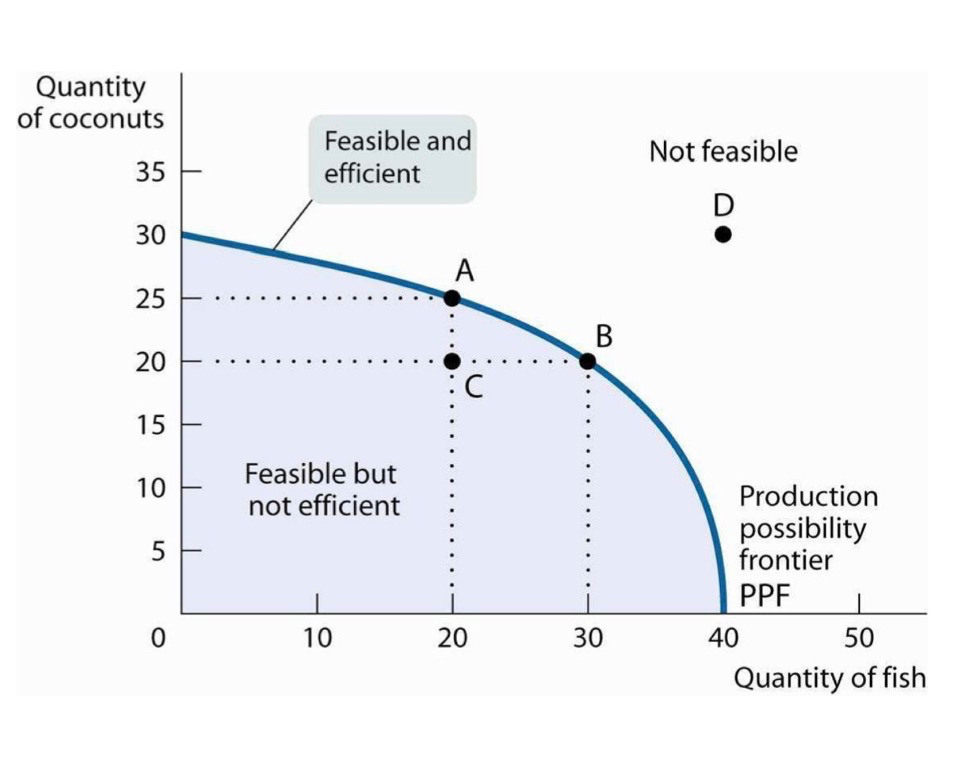
These are points lying on the PPF curve, indicating that the available resources are being used to their full potential.
Inefficient Production Points
Points inside the PPF indicate underutilization of resources, meaning that more of one or both goods could be produced with the available resources.
Unattainable Production Points
Points outside the PPF represent combinations of goods that cannot be obtained with the current resources and technology.
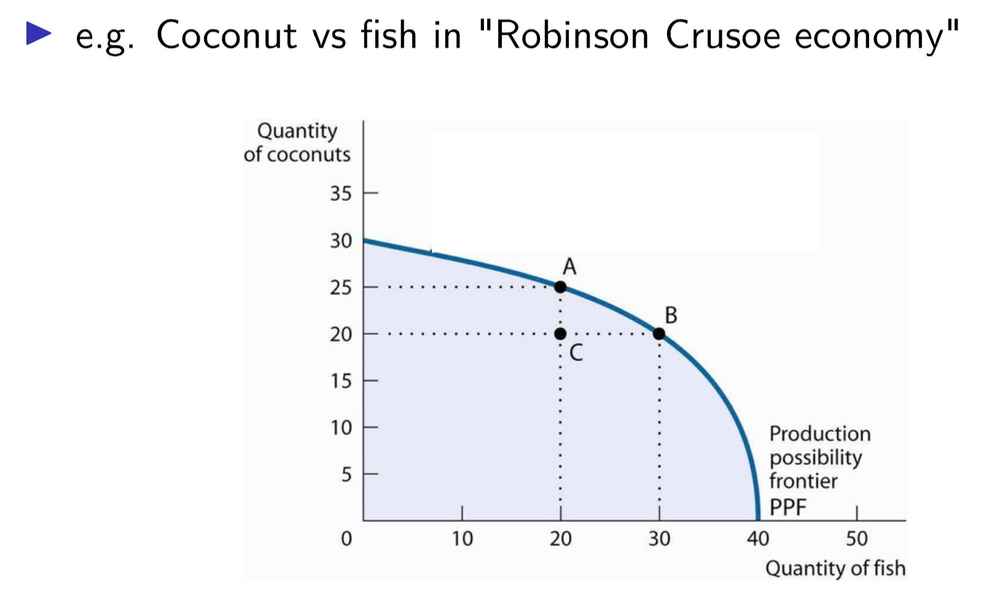
Points on the curve signify efficient production as all resources are optimally utilized. Conversely, points inside the curve denote inefficiency, reflecting underuse of resources. Points outside are unattainable with current means, indicating the need for more resources or technological improvement.
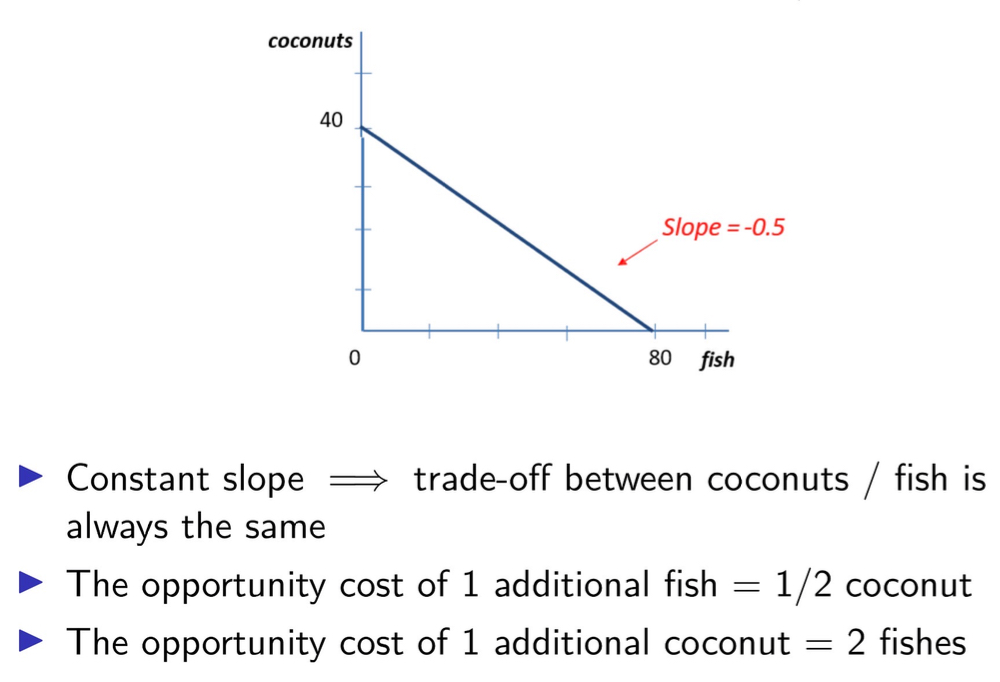
The slope of the PPF curve is crucial as it indicates the opportunity cost, or sacrifice, of producing one good over another. A steeper slope means a higher opportunity cost, meaning more of one good has to be given up to produce additional units of another.
 Linear vs. Curved PPF
A linear PPF suggests constant opportunity costs, indicating that resources are perfectly adaptable for the production of both goods. In contrast, a bowed-out (curved) PPF suggests increasing opportunity costs. This curvature demonstrates that as more of one good is produced, increasingly larger amounts of the other good must be sacrificed, reflecting specialized resource allocation.
 Autarky and Gains from Trade
Autarky refers to an economy or country that is self-sufficient and does not trade with others. Under autarky, a country is restricted to its PPF for consumption. However, engaging in trade allows countries to achieve levels of consumption beyond their PPF by specializing in the production of goods in which they have a comparative advantage, thus realizing gains from trade.
To remember :
- The PPF illustrates the trade-offs and opportunity costs in production.
- Efficient points lie on the PPF, inefficient points lie inside, and unattainable points lie outside.
- The slope of the PPF indicates the opportunity cost of producing goods.
- A linear PPF suggests constant opportunity costs; a curved one indicates increasing costs.
- Autarky restricts an economy to its PPF, while trade allows for consumption beyond it through specialization.