
Trolley Problem
What Princinples emerge from the Trolley Problem ?
- Our actions should :
- Promote overall happiness/utility
- Utilitarianism
- Respect human dignity, individual rights
- Ethics of Duty / Deontology
- Conform to some other principle
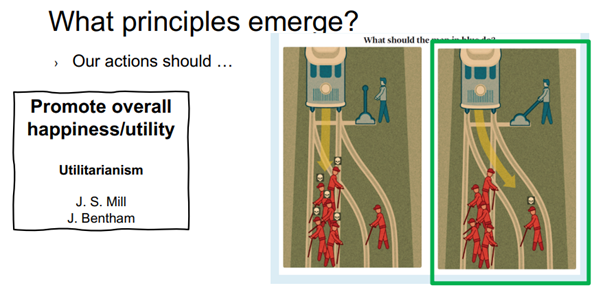
Utilitarianism
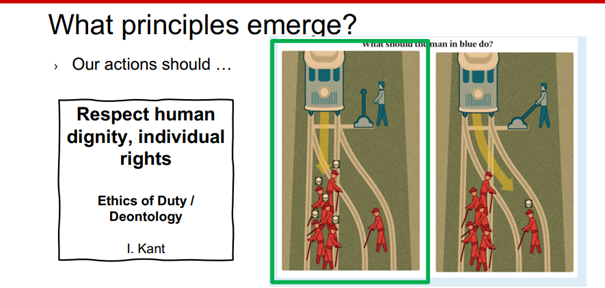
Ethics of Duty / Deontology
Définition
Utilitarianism
Utilitarianism is the normative ethical theory that says that we should act in ways that produce the most pleasure or happiness (and the least amount of suffering) for the greatest number of people affected by our actions.
Principle of Utility = Greatest Happiness Principle : Actions are right if they promote the greatest amount of pleasure/happiness/utility, and wrong if they do not
- The Greatest Happiness Principle enables us to calculate the morally right thing to do
- We need to factor in three ingredients :
- Consequences
- Happiness/utility
- Equality
Consequences
- "All action is for the sake of some end, and rules of action must take their whole character and colour from the end to which they are subservient"
Happiness / Utility
- "The ultimate end is an existence exempt as far as possible from pain, and as rich as possible in enjoyments, both in point of quantity and quality"
Equality (everyone counts exactly once)
- "As between his own happiness and that of others, utilitarianism requires him to be as strictly impartial as a disinterested and benevolent spectator"
Ethics of Duty
- Moral prescriptions are universal : everyone would assent to them if they considered them rationally
- Fundamental principle of morality is Kant's Categorical Imperative
- Categorical ("Do A!") as opposed to hypothetical ("if you want to reach goal G, then do A!")
- Imperative ("Do A!") because it's an order, not a request or a recommandation
- The categorical imperative :
- A tool to derive moral laws. Three versions :
- Universalizability
- "Act only according to that maxim whereby you can at the same time will that it should become a universal law without contradiction."
- Respect for autonomy
- "Act is such a way that you treat humanity, whether in your own person or in the person of any other, never merely as a means to an end, but always at the same time as an end."
- Universalizability
- What if everyone did that ?
- Act only according to principles that you can think and want to be universal principles
- Think : imagine a world in which all people act according to a principle (without contradiction!)
- Want : ask if such a world would be a good one to live in, for you and others
- Respect for autonomy
- "Treat people as ends in themselves never as a means only."
- Respect each other as rational, autonomous persons
- Autonomy to set goals
- Autonomy to reach goals
- Respect, so do not hamper, frustrate
- Autonomy, so it's about freedom
Virtue Ethics
- Utilitarianism and Katian ethics focus on the moral qualities of our actions
- Virtue ethics focuses on the moral qualities of our character
- According to virtue ethics, good actions fome from good persons
- We should try to develop morally good character traits (virtues):
- Courage
- Generosity
- Patience
- Etc
Virtue
- Character trait, disposition that has some cross-situational consistency
- Tendency to respond in particular way
- Aquired, so you can learn to become generous, openminded etc
- Virtue lies in between extremes (excess and deficit)
- Cowardice
- Courage : exactly right
- Recklessness
"The good life"
- Developing a virtuous character is part of what it means to live a good life (Aristotle)
Virtue ethics in business
- Virtues can appear at individual and corporate level
- Employees in R&D need to be inquisitive and openminded (virtues have to match functions)
- Corporations have to support virtue
- Corporation have to remedy vice
Rights and justice
Rights
- Human rights are basic entitlements that should be respected always and everywhere
Justice
- Justice requires fair or equal treatment
- Fair procedures (procedural justice)
- Fair outcomes (distributive justice)
Questions of justice
- Two positions :
- Strict egalitarianism
- Justice = equal distribution of good burdens
- Non-egalitarianism
- Equality has no intrinsic value
- Justice must be realized elsewhere, for example through fair process of the market
Strict egalitarianism
- Justice is equality
- Everyone should have the same amount of goods, burdens, and services
- Problem
- Equal distribution of material goods does not necessarily give more well-being to all
- What about getting what we deserve ? Or what we need ?
Non egalitarianism
- Equality has no intrinsic value, so justice must be realized elsewhere
- For example, through the fair process of the market
- Robert Nozick argues that a just distribution of goods is one in which each person is entitled to their possessions :
- Fair acquisition
- Fair transfer
- Problems
- The problem assumes equal participants, but differences in income, ability, health, luck often prevail and lead to apparently unjust outcomes
How should we decide on principles of justice ?
- When we have to decide on how to distribute goods in society, we often differ in what we think is right or wrong according to our position in society
- Rawls proposes a thought experiment
- Suppose individuals were allowed to choose the principles of justice that should govern them - and they choose before any existing political or social arrangement
- Which principles would they endorse ?
- To eliminate any biases and ensure a fair outcome, we should imagine ourselves behind a veil of ignorance :
- What principles would we endorse if we didn't know anything about our economic background talents, privileges ?
The nature of choice
- According to Rawls :
- Individuals in the original position will want more, rather than less, of the so-called primary goods
- Individuals will follow the maximin principle - they will choose conservatively, by trying to maximize the minimum of these preimary social goods they will receive
Two key principles for justice
- All people have same basic liberties (human rights)
- Social and economic inequalities are allowed, but only if they are
- To the greatest benefit of the least advantaged
- Attached to offices and positions open to all under conditions of equality of opportunity (so no discrimination)
A retenir :
For Rawls, high salaries and bonuses are justified if the least well-off profit more than in any other arrangement
Définitions
Utilitarianism
Utilitarianism is the normative ethical theory that says that we should act in ways that produce the most pleasure or happiness (and the least amount of suffering) for the greatest number of people affected by our actions.