1. Economic, Social, and Cultural (ESC) Rights: Overview
Historical Context
- Post-WWII saw a divide in human rights ideologies: the Soviet bloc advocated for ESC rights, while Western countries prioritized civil and political rights, arguing ESC rights depend on economic factors and are not immediately realizable.
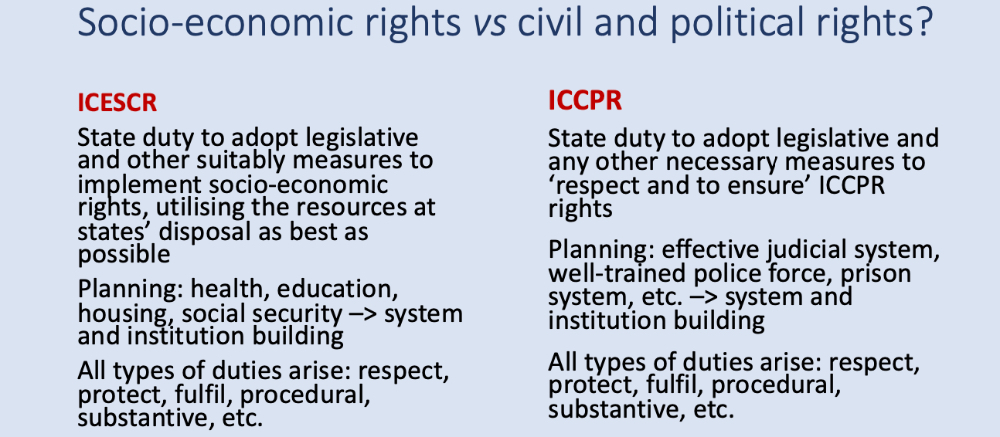
- UN Commission on Human Rights therefore decided to draft two Covenants to resolve deadlock (ICCPR and ICESCR in 1966).
- The 1980s saw further skepticism in the West due to neoliberal policies promoting small government and privatization, often to the detriment of public services and social welfare.
- A tendency particularly worsened by globalisation permitting concentration of global assets in the hands of ever fewer ultra-wealthy individuals, multinational corporations, financial institutions, asset managers (Global Wealth Report 2024, pp.23-24).
The CESCR's General Comment No. 3 (1990) addresses two crucial principles in interpreting obligations under the International Covenant on Economic, Social and Cultural Rights (ICESCR):
Progressive Realization (Article 2(1), ICESCR)
The principle of progressive realization acknowledges that states may not be able to fully achieve all ESC rights immediately, due to resource constraints, therefore, they must use the maximum of their available resources to achieve progressively the full realization of the rights over time, including particularly the adoption of legislative measures(same goes for the ICCPR (art.2(1)&(2) ICCPR).
However, General Comment No. 3 sets clear expectations on how this flexibility should be applied:
- States are required to take concrete, targeted actions shortly after the Covenant enters into force.
- The concept of progressive realization should not be misused to delay or dilute obligations ; the CESCR emphasizes that states are under an ongoing duty to act "as expeditiously and effectively as possible" towards fulfilling these rights.
Minimum Core Obligations
To ensure that the Covenant retains meaningful impact, the CESCR has identified a minimum core obligation which forces states to fulfill essential levels of each right immediately, regardless of their economic situation.
- States must ensure that all individuals have access to basic necessities for survival, including food, primary health care, basic shelter, and primary education.
- Failing to meet these essential needs for a significant portion of the population constitutes a breach of the Covenant.
- This approach highlights the raison d’être of the Covenant which is protecting basic human dignity by ensuring that fundamental needs are met as a priority.
In summary, while the ICESCR recognizes gradual implementation, it imposes an immediate duty on states to meet these "minimum core" obligations, in order to uphold human dignity while allowing for realistic progress over time in achieving full ESC rights.
2. The Human Right to Housing
Fundamental Human Interest
The UN Special Rapporteur’s 2015 report on homelessness highlights the profound social and human rights issues emerging from homelessness, emphasizing why the right to housing deserves protection as a fundamental human right
- Homelessness often leads to stigmatization with homeless individuals perceived as a distinct social group.
- Homeless individuals face systematic exclusion from essential services, including sanitation facilities, healthcare, and social assistance and are often removed from public spaces to be relocated in inhospitable areas.
- Homeless people experience frequent intimidation and harassment by authorities and the public and are particularly exposed to extreme violence, including hate crimes and sexual violence.
Treaty Provisions Supporting the Right to Housing
- Art. 25 UDHR recognizes that everyone has the right to an adequate standard of living for their health and well being of themselves and their family, which includes, among other things, food, clothing, housing, medical care and security.
- Art. 11 ICESCR, requires states to ensure adequate living conditions for every individual and his family, which include adequate housing, as a core component of well-being.
- CESCR General Comment 4 (para.8) lists "adequate housing" criteria, such as security of tenure, necessary services, affordability, habitability, appropriate location (Irish travelers) and cultural adequacy.
- CESCR, General Comment 4 (para.12) states that the means to achieve full realization of the right to adequate housing might vary from one state to another but states still have to take the necessary steps to ensure that right which "will almost invariably require the adoption of a national housing strategy ...".
3. Principles for a Rights-Based Housing Strategy (UN Special Rapporteur's 10 key principles - A/HRC/37/53)
A- Legal Basis
- Legislation should secure housing rights, possibly through constitutional provisions or specific housing laws.
- Effective laws should aim to eliminate homelessness, restrict evictions of homeless people, and regulate private entities (e.g., landlords, real estate developers, AirBnB).
B- Prioritizing Those Most in Need and Ensuring Equality
- Housing strategies should focus on the needs of the most vulnerable, such as the homeless and people in dangerous living conditions (minimum core duty).
- Anti-discrimination measures must be in place to avoid societal inequalities.
C- Comprehensive Strategy Involving All Levels of Government
- A holistic strategy (=provide support for the mental health needs and the physical, emotional, social and spiritual wellbeing of a person) should address issues impacting housing availability, such as rent regulation, prevention of land-grabbing, and providing housing subsidies.
- Coordination among local, regional, and national governments is essential.
D- Participation
- Affected communities, especially vulnerable populations like the homeless, should be involved in decision-making processes, especially rights-based housing policies and laws.
- This participation promotes democratic accountability, recognizes the dignity of rights-holders, and prevent the dominance of profit-driven interests in housing policies.
E- Accountable Budgeting and Tax Justice
- States should allocate adequate resources and address tax issues that compromise housing access, such as tax avoidance in the housing sector.
- Measures may include eliminating preferential tax treatment for investors that drive up housing costs.
F- Human Rights-Based Goals and Timelines
- States should establish both short and long-term goals that are realistic and human rights-oriented (e.g. short-term goals might focus on immediate housing needs for homeless populations, while long-term goals could aim at sustainable housing development).
G- Accountability and Monitoring
- Mechanisms to monitor housing strategies should include local authorities, National Human Rights Institutions (NHRIs), and Ombuds-institutions (=independent oversight bodies that receive complaints and investigate matters pertaining to the protection of HR and prevention of maladministration) which ensures oversight, prevents corruption, and allows for responsive measures if housing policies fail to meet human rights standards.
H- Access to Justice and Remedies
- States must provide accessible legal remedies for individuals whose right to adequate housing is violated.
- Mechanisms may include courts and non-judicial bodies capable of holding both government and private actors accountable.
- Art.2(3)(b) ICCPR and Art.13 ECHR – right to an effective remedy (=obligation to bring to justice perpetrators of human rights abuses, including discrimination, and also to provide appropriate reparation to victims).
I- Clarifying Responsibilities of Private Actors
- Ensuring that private entities in the housing market, such as developers and corporate landlords, respect housing rights and actively contribute to their realization.
- Promote alternative forms of housing investments that ensure sustainable access to adequate housing: non-profit community and collective ownership models.
J- International Cooperation and Assistance
- States with limited resources should seek international assistance to implement housing strategies.
- International action is also necessary to address issues like global tax havens and financial market transparency that impact national housing markets.
- Art.2(1) ICESCR: Each State Party must take steps, individually and through international assistance and co-operation, to progressively achieve the full realization of the rights recognized in the Covenant.
4. CESCR’s Jurisprudence on Forced Evictions
The CESCR addresses evictions through the lens of the right to adequate housing, as recognized in Article 11(1) of the ICESCR and according to the Committee, this right implies protection against arbitrary or unjustified evictions, regardless of the occupant's legal tenure status.
1- Scope of Protection Against Evictions
The CESCR emphasizes a "tenure-neutral" approach:
- Everyone has a right to housing protection, including individuals who occupy housing illegally (e.g. squatters).
- While the right to housing includes those without legal tenure, lack of formal ownership can serve as a legal justification for eviction in some circumstances, especially if it serves a legitimate public or private interest.
2- Evictions as a Limitation to the Right to Housing
Evictions are recognized as a potential limitation to housing rights, and therefore, they must meet specific standards to be legally justified under the ICESCR.
- Evictions must be grounded in domestic law, which should be flexible enough to consider vulnerable residents and the proportionality of the action.
- Evictions can be justified if they meet legitimate goals, such as protecting property rights or promoting the general welfare (e.g. owners reclaiming their property).
- Three-Part Proportionality Test: To determine if an eviction is proportionate, the CESCR suggests a three-step test:
- Suitability: The eviction should be appropriate for achieving a legitimate aim (e.g., property recovery).
- Necessity: Evictions must be the last resort; deferring eviction until alternative housing is secured or providing rent subsidies, should be considered.
- Proportionality in the "strict sense": The legitimate aim of promoting general welfare/protection of property rights of the owners cannot outweigh the impact the eviction will have on the individual, particularly the enjoyment of his right to housing (e.g. immediate evictions are generally considered disproportionate due to the severe disruption they cause to individuals’ lives).
- Role of Domestic Courts: The CESCR prefers that national courts conduct proportionality analyses in eviction cases in order to respect the principle of subsidiarity (=the authority who is the competent and close to the issue takes the decision), allowing national courts, with greater access to contextual information, to make nuanced decisions.
3- Procedural Requirements for Lawful Evictions
The CESCR mandates that evictions follow fair procedural standards:
- Consultation: Authorities must conduct genuine consultations with those affected by evictions to explore possible alternatives.
- Notice: Reasonable period of notice must be given to those facing eviction, allowing them to prepare/seek alternative housing.
- Judicial or Independent Review: Evictees should have access to a judicial or other independent body to review the eviction, ensuring it meets legal and proportionality standards.
4- Obligation to Provide Alternative Housing
The CESCR has clarified that states have a duty to provide alternative adequate housing to some evicted persons, especially when eviction would result in homelessness.
- States are obligated to act when evicted individuals can't afford alternative housing by their own means.
- “All "appropriate measures” to "maximum available resources" must be taken to create alternative housing options, which includes focusing on structural and institutional reforms where necessary.
- Alternative housing must meet basic adequacy standards, which include:
- Even temporary housing must provide stability and meet minimal standards of adequacy.
- Alternative housing should be appropriate to personal needs, with accommodations for families or the elderly to prevent separation of family members.
- While temporary emergency housing may be acceptable under extreme conditions, states must aim to secure permanent housing solutions.
- Right to Refuse Alternative Offers: Evictees have the right to refuse housing that does not meet minimum adequacy standards or fails to respect human dignity.
5- Evaluation of CESCR’s Jurisprudence on Evictions
The CESCR’s approach to forced evictions is centered on balancing property rights with housing rights, but it raises some challenges:
- Property Rights: While the CESCR recognizes property rights, particularly for individual owners, there is less emphasis on the rights of financial institutions, which aims to prioritize human rights but can create tension with property interests, especially in countries with strong property rights protections.
- Potential Backlash Against the Optional Protocol: Some states might be reluctant to ratify the Optional Protocol to the ICESCR, which allows individual complaints, fearing that CESCR’s housing recommendations could impose significant burdens on national housing systems.
- CESCR’s Recommendations to Prevent Future Violations: While the CESCR’s recommendations are generally seen as constructive, there is debate over whether some of these guidelines may exceed its mandate by prescribing detailed national policies.