
Partielo | Créer ta fiche de révision en ligne rapidement
College or University

Hudson River School and The Sublime

Definitions

Hudson River School
The Hudson River School was a mid-19th century American art movement embodied by a group of landscape painters whose aesthetic vision was influenced by romanticism. Thomas Cole, Albert Bierstadt, Frederic Ewin Church, Thomas Doughty, John Frederick Kensett.
The Sublime
The sublime is a quality of greatness or grandeur that inspires awe and wonder, often associated with nature's vastness and beauty. It is beyond human comprehension or calculation

Founding and Influence of the Hudson River School

The Hudson River School was founded by Thomas Cole in the 1820s. This group of artists is celebrated for their depictions of the American wilderness, particularly that of the Hudson River Valley and the surrounding area. The movement was greatly influenced by European Romanticism, emphasizing emotional engagement with the natural world. These artists sought to capture the ethereal beauty and ruggedness of the American landscape, highlighting the potential for both national pride and personal reflection.

Key Artists and Works

Several notable artists were part of the Hudson River School, each contributing significantly to the movement. Thomas Cole, often considered the father of the school, was known for works like 'The Oxbow' and 'The Course of Empire,' which depicted the transformative power of nature. Asher B. Durand is another key figure, recognized for his precise portrayal of trees and forest scenes. Frederic Edwin Church, a prominent second-generation member, explored distant vistas, as seen in his painting 'Niagara.' These artists collectively advanced an aesthetic that celebrated American landscapes by blending detailed realism with idealized beauty.

Exploration of The Sublime

The Hudson River School artists were deeply inspired by the concept of the sublime, as defined by philosophers like Edmund Burke and Immanuel Kant. This concept was characterized by an overwhelming sense of awe or wonder, often provoked by nature's power and magnitude. These artists aimed to evoke such feelings through their depictions of grandeur landscapes, waterfalls, mountains, and skies. Their works frequently featured dramatic contrasts between light and shadow, vastness and intimacy, capturing the transcendental beauty of untouched places.

  1. Overwhelming greatness: The sublime is characterized by its vastness, power, or magnificence that surpasses ordinary human experience or understanding
  2. Transcendence: It represents something that goes beyond the limits of human perception, reason, or imagination
  3. Emotional impact: The sublime evokes a mix of amazement, fear, and pleasure. It can create a sense of "agreeable kind of horror" or fearful admiration
  4. Contrast with beauty: Unlike beauty, which is associated with form and boundaries, the sublime is often formless and boundless
  5. Cognitive challenge: The sublime presents an experience that challenges our ability to fully comprehend or represent it, pushing the limits of our faculties
  6. Moral and intellectual elevation: It can refer to greatness in moral, intellectual, or spiritual realms, not just physical or aesthetic domains
  7. Transformative experience: Encountering the sublime can lead to a profound shift in perspective or self-awareness
  8. Natural manifestations: While often associated with natural phenomena (like vast landscapes or powerful storms)

Comparison to European Romanticism

While the Hudson River School painters were influenced by European Romanticism, they distinguished themselves through their focus on the American landscape. European artists often depicted already cultivated and populated scenes, contrasting with the expansive, untamed wilderness that American painters spotlighted. The Hudson River School illustrated an Edenic vision of America, reflecting themes of discovery, exploration, and the divine in nature. This uniquely American perspective by these American painters marked a departure from European artistic traditions, fostering a nationalistic approach.

Legacy and Influence

The legacy of the Hudson River School extends beyond art, influencing American attitudes toward conservation and the environment. The school's reverence for nature played a part in shaping the national parks movement, as people became more aware of preserving the wilderness depicted in these paintings. These artists' works continue to impact contemporary environmental art and discussion, emphasizing humanity's relationship with nature. Moreover, their art serves as a reminder of America's natural beauty and the importance of environmental stewardship.

To remember :

The Hudson River School was a major artistic movement that celebrated the American landscape through a romantic lens influenced by European ideals. Its artists like Thomas Cole and Frederic Edwin Church were pivotal in shaping an art style rooted in the sublime and picturesque, drawing upon vast, untamed wilderness scenes. They articulated a vision that was both a celebration of nature's grandeur and a manifestation of American identity. This school not only influenced the art world but also helped pioneer early environmentalism, highlighting nature's beauty and humanity's responsibility toward its preservation.
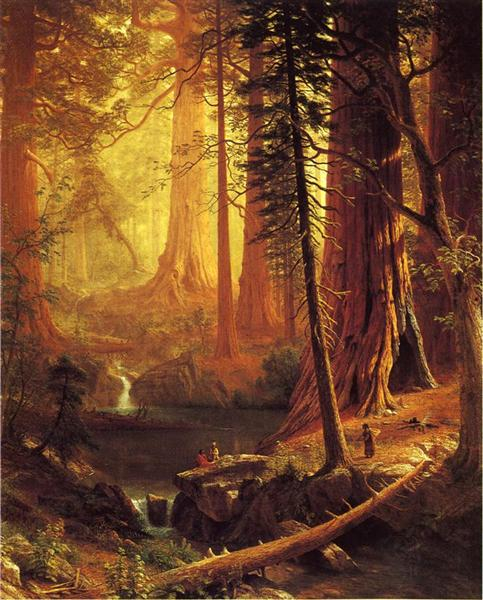
Giant Redwood Trees of California, Albert Bierstadt, 1874

College or University

Hudson River School and The Sublime

Definitions

Hudson River School
The Hudson River School was a mid-19th century American art movement embodied by a group of landscape painters whose aesthetic vision was influenced by romanticism. Thomas Cole, Albert Bierstadt, Frederic Ewin Church, Thomas Doughty, John Frederick Kensett.
The Sublime
The sublime is a quality of greatness or grandeur that inspires awe and wonder, often associated with nature's vastness and beauty. It is beyond human comprehension or calculation

Founding and Influence of the Hudson River School

The Hudson River School was founded by Thomas Cole in the 1820s. This group of artists is celebrated for their depictions of the American wilderness, particularly that of the Hudson River Valley and the surrounding area. The movement was greatly influenced by European Romanticism, emphasizing emotional engagement with the natural world. These artists sought to capture the ethereal beauty and ruggedness of the American landscape, highlighting the potential for both national pride and personal reflection.

Key Artists and Works

Several notable artists were part of the Hudson River School, each contributing significantly to the movement. Thomas Cole, often considered the father of the school, was known for works like 'The Oxbow' and 'The Course of Empire,' which depicted the transformative power of nature. Asher B. Durand is another key figure, recognized for his precise portrayal of trees and forest scenes. Frederic Edwin Church, a prominent second-generation member, explored distant vistas, as seen in his painting 'Niagara.' These artists collectively advanced an aesthetic that celebrated American landscapes by blending detailed realism with idealized beauty.

Exploration of The Sublime

The Hudson River School artists were deeply inspired by the concept of the sublime, as defined by philosophers like Edmund Burke and Immanuel Kant. This concept was characterized by an overwhelming sense of awe or wonder, often provoked by nature's power and magnitude. These artists aimed to evoke such feelings through their depictions of grandeur landscapes, waterfalls, mountains, and skies. Their works frequently featured dramatic contrasts between light and shadow, vastness and intimacy, capturing the transcendental beauty of untouched places.

  1. Overwhelming greatness: The sublime is characterized by its vastness, power, or magnificence that surpasses ordinary human experience or understanding
  2. Transcendence: It represents something that goes beyond the limits of human perception, reason, or imagination
  3. Emotional impact: The sublime evokes a mix of amazement, fear, and pleasure. It can create a sense of "agreeable kind of horror" or fearful admiration
  4. Contrast with beauty: Unlike beauty, which is associated with form and boundaries, the sublime is often formless and boundless
  5. Cognitive challenge: The sublime presents an experience that challenges our ability to fully comprehend or represent it, pushing the limits of our faculties
  6. Moral and intellectual elevation: It can refer to greatness in moral, intellectual, or spiritual realms, not just physical or aesthetic domains
  7. Transformative experience: Encountering the sublime can lead to a profound shift in perspective or self-awareness
  8. Natural manifestations: While often associated with natural phenomena (like vast landscapes or powerful storms)

Comparison to European Romanticism

While the Hudson River School painters were influenced by European Romanticism, they distinguished themselves through their focus on the American landscape. European artists often depicted already cultivated and populated scenes, contrasting with the expansive, untamed wilderness that American painters spotlighted. The Hudson River School illustrated an Edenic vision of America, reflecting themes of discovery, exploration, and the divine in nature. This uniquely American perspective by these American painters marked a departure from European artistic traditions, fostering a nationalistic approach.

Legacy and Influence

The legacy of the Hudson River School extends beyond art, influencing American attitudes toward conservation and the environment. The school's reverence for nature played a part in shaping the national parks movement, as people became more aware of preserving the wilderness depicted in these paintings. These artists' works continue to impact contemporary environmental art and discussion, emphasizing humanity's relationship with nature. Moreover, their art serves as a reminder of America's natural beauty and the importance of environmental stewardship.

To remember :

The Hudson River School was a major artistic movement that celebrated the American landscape through a romantic lens influenced by European ideals. Its artists like Thomas Cole and Frederic Edwin Church were pivotal in shaping an art style rooted in the sublime and picturesque, drawing upon vast, untamed wilderness scenes. They articulated a vision that was both a celebration of nature's grandeur and a manifestation of American identity. This school not only influenced the art world but also helped pioneer early environmentalism, highlighting nature's beauty and humanity's responsibility toward its preservation.

Giant Redwood Trees of California, Albert Bierstadt, 1874