
Partielo | Créer ta fiche de révision en ligne rapidement

Foundations of Criminology: A Strategic Synthesis of Crime, Theory, and Policy

1. The Definitional Framework: Crime, Deviance, and Delinquency
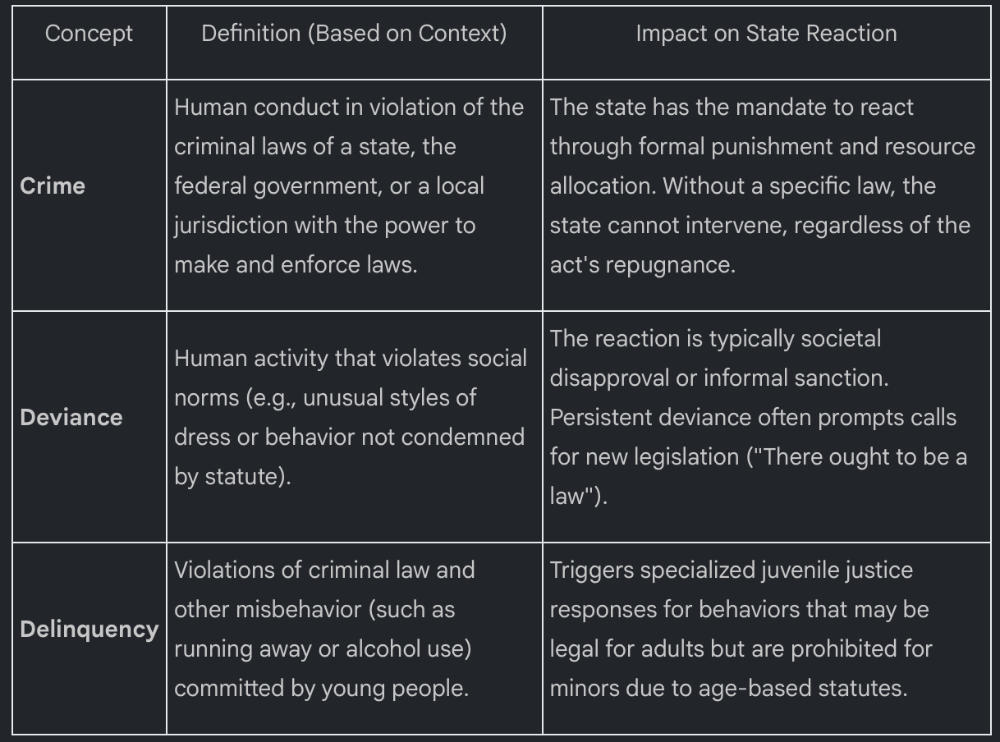
In the professional spheres of social policy and law, the strategic importance of precise definitions cannot be overstated. Clear boundaries ensure that state interventions are not arbitrary but are grounded in specific jurisdictional powers. For a policy consultant, these definitions are the fulcrum upon which agency mandates and budget allocations turn; they dictate which behaviors require a law enforcement response and which remain under the purview of social service or community norms. By defining conduct through formal statutes, the state establishes a predictable framework for legitimate punishment. Without these precise legal markers, the distinction between a social faux pas and a punishable offense remains blurred, complicating the objective of maintaining public order within a rule-of-law framework.

Synthesizing the "legalistic perspective" as championed by Edwin Sutherland, crime is essentially behavior prohibited by the State as an injury to the State. However, a sophisticated analysis must recognize that laws are social products. Sutherland’s perspective suggests that powerful individuals in positions to influence law-making can impose their preferred definitions of behavior. Consequently, those with sufficient political capital may escape the "criminal" label entirely, ensuring their own wrongdoings are not reflected in statutory law, thereby avoiding punishment.

This reliance on statutory definitions shifts the focus from the act itself to the societal and political frameworks used to decide which behaviors should be criminalized.

2. Societal Perspectives on Criminalization: Consensus vs. Pluralism

In diverse modern societies, determining the legal status of controversial behaviors—ranging from gambling and prostitution to same-sex marriage and biomedical research—is rarely a matter of universal agreement. The process of criminalization reveals deep-seated tensions between different worldviews regarding morality, personal freedom, and the role of government. How a society navigates these tensions determines the very fabric of its legal code.


• Consensus Perspective

    ◦ Core Assumptions: This model holds that laws should be enacted when members of society agree that such laws are necessary. it presumes a homogeneous population with shared values, norms, and belief systems.

    ◦ Impact on Law-Making: In this view, the law is a reflection of the collective will. It is most applicable to uniform cultures where "right" and "wrong" are universally accepted, making the legislative process a straightforward codification of social agreement.


• Pluralist Perspective

    ◦ Core Assumptions: This perspective recognizes the inherent diversity of multicultural societies like the United States. It assumes that different groups will naturally have competing interests, values, and beliefs.

    ◦ Impact on Law-Making: Behaviors are criminalized through a political process involving intense debate and appellate court interpretations. The law serves as a settled point or a compromise after various interest groups—such as gun control proponents versus opponents—have utilized the political and legal systems to advance their agendas.


The "So What?" for policy makers is the realization that in multicultural populations, universal agreement is an unrealistic benchmark. Instead, the criminalization of behavior is dictated by the political process and the ability of specific groups to influence legislation. Law-making is not a neutral act of moral consensus but a strategic political outcome. This process directly shapes the landscape for the professionals who must study and manage its effects.

3. The Criminological Enterprise: Roles and Disciplines

Strategically, it is vital to differentiate between the academic study of crime and the practical, day-to-day operation of the justice system. While these fields overlap, their objectives, training requirements, and contributions to the state's mission are distinct. Edwin Sutherland defined the essence of this enterprise as a three-part process: the making of laws, the breaking of laws, and the reacting toward the breaking of laws.


Criminologists vs. Criminalists vs. CJ Professionals
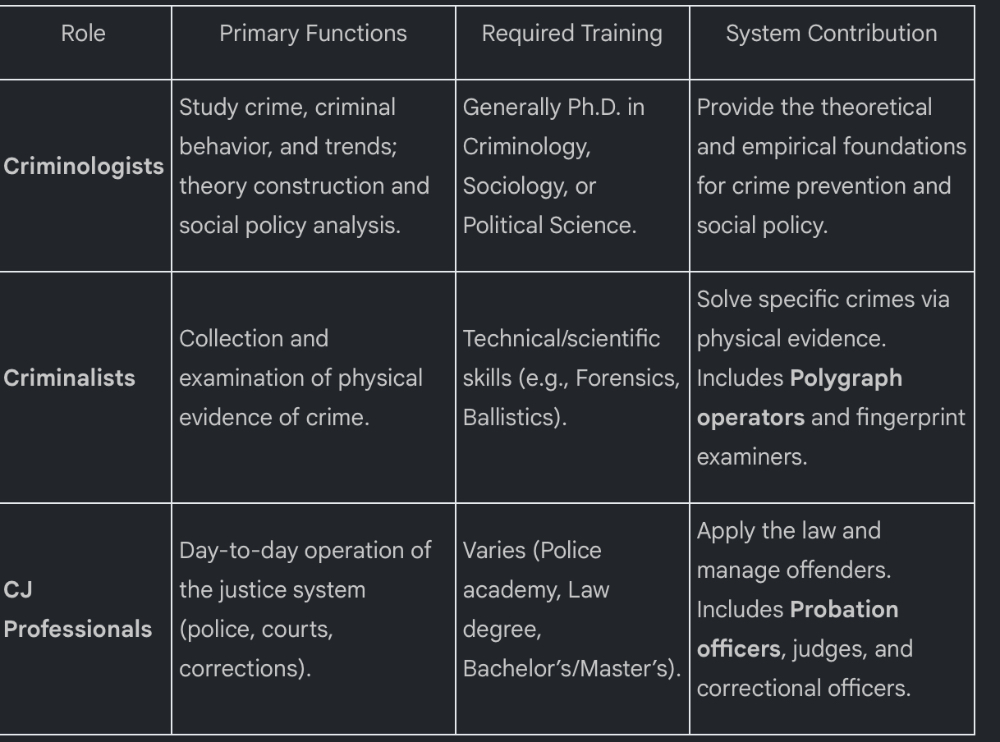
The primary activities of a criminologist are expansive, including data gathering, crime-pattern analysis, hypothesis testing, theory construction, and the creation of social policy. They also engage in public advocacy and serve as expert witnesses in court proceedings.

Criminology is inherently interdisciplinary, drawing from diverse fields to provide a holistic understanding of crime. Key contributing fields include:

1. Sociology: Impacts the field by placing the criminal event in its social context, viewing crime as a social phenomenon rather than just an individual choice.

2. Biology: Shifts the focus toward genetics and DNA, helping explain why one individual may become violent while another in the same environment does not.

3. Economics: Changes the study of crime by introducing "rational choice" models and analyzing the financial motivations and systemic resource impacts of offending.

4. Psychology/Psychiatry: Provides insights into individual mental processes and character, moving the study toward clinical and behavioral explanations.

5. Political Science: Explores how power and the legislative process define criminality, emphasizing that crime is a political construction.

These diverse contributions allow professionals to develop the complex theoretical models necessary to explain why criminal behavior occurs.

4. Theoretical Paradigms and Social Relativity

In the evolution of criminology, the field has moved from simple description to causal explanation. This strategic shift is essential for developing interventions that go beyond mere reaction to active prevention.

• General Theory: Attempts to explain most forms of criminal conduct through a single, overarching approach.

• Unicausal Theory: Posits a single identifiable source for all serious deviant and criminal behavior. As a consultant, one must view these with professional skepticism; it is difficult to imagine a single factor explaining everything from corporate fraud to serial murder. Most scholars regard such narrow views as "organized conjecture."

• Integrated Theory: Merges concepts from biological, social, and cultural sources. These are increasingly favored in modern research as they reflect the inherent complexity of crime.


The meaning of crime is further complicated by Social Relativity and Social Construction, which suggest that crime is a social event interpreted differently by participants:

1. The Offender: May interpret the act as a survival strategy, a thrill, or a justified response to their circumstances.

2. The Victim: Views the event through the lens of personal trauma and the loss of security.

3. The Justice Agent: Interprets the event as a case to be processed, a statute violation to be managed, or a statistic to be cleared.


Because criminal activity is "diversely created and variously interpreted," these subjective meanings can cloud our understanding of the phenomenon. This fundamental subjectivity necessitates the use of objective, empirical methods to bridge the gap between individual interpretation and the reality of crime incidence.

5. Quantifying Criminality: Measurement Systems and the "Dark Figure"

Accurate data is the cornerstone of justice strategy. Without reliable measurement, it is impossible to track trends or allocate resources effectively.
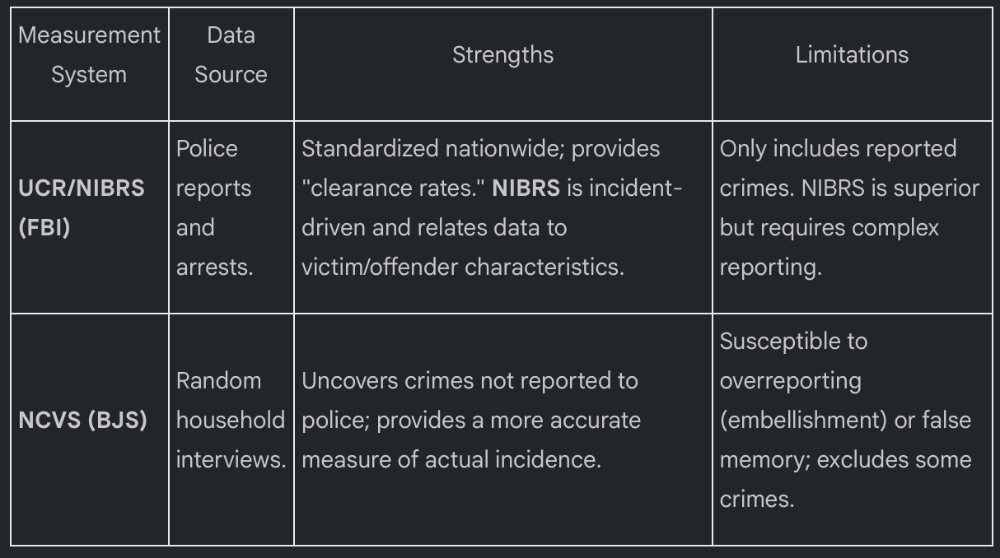
NIBRS represents a significant advancement, collecting detailed data on 46 "Group A" offenses across 22 categories. Its incident-driven nature allows for a much more granular understanding of the circumstances surrounding a crime.


A critical challenge is the "Dark Figure of Crime," which includes the large volume of unreported and undiscovered crimes. Based on Figure 1-9, we must distinguish between:

• Unreported Crimes: Known to the victim but not the police.

• Undiscovered Crimes: Unknown to both the victim and the police.


While property crime victims often report for insurance purposes (Motor vehicle theft has an 83% report rate), larceny is the most underreported at 32%. Regarding violent crimes, victims most commonly fail to report because they view the event as a "personal or private matter" or because the "offender was unsuccessful" (attempted crimes). These data collection methods provide the raw material for identifying the historical patterns that define our social stability

6. Historical Trajectories: Shifts in U.S. Crime Rates

Understanding historical crime cycles is strategically important for predicting future shifts in social stability. U.S. crime rates since 1933 have followed three distinct trajectories:

1. 1933–1959 (The Decline): Crime decreased sharply in the early 1940s. The primary driver was WWII, as the crime-prone young male population entered military service.

2. 1960–1989 (The Surge): Rates skyrocketed as the "Baby Boom" generation entered their teens. This era was defined by social upheaval, the Vietnam War, and an influx of drugs.

3. 1990–2012 (The Great Decline): Crime rates dropped to a 40-year low by 2012. Significant drivers included an aging population, expanded police funding, and an economic expansion where unemployment decreased by 36%.


We are now facing a potential "Fourth Shift." Current indicators suggest a threat to social stability: economic uncertainty and high jobless rates among unskilled workers are converging with a growing number of ex-convicts returning to the streets due to state budget deficits and prison closures. When combined with the increasing influence of violent gangs and "copycat" crimes, these factors may lead to a sustained increase in crime. These historical trends underscore the urgent need for scientific evidence when crafting social policy to maintain the peace.

7. Evidence-Based Criminology and Social Policy

To ensure that government initiatives are effective rather than merely performative, the field has moved toward Evidence-Based Criminology (utilizing randomized controlled experiments) and Translational Criminology. Translational criminology focuses on the powerful idea of converting scientific discoveries into workable social policy and practice—moving research from the journal to the real world.


The difficulty of this transition is starkly visible in the debate over media violence. By the time the average U.S. schoolchild leaves elementary school, he or she will have witnessed more than 8,000 murders and 100,000 other acts of violence on television. Despite over 30 years of research by the American Medical Association (AMA), the American Psychological Association (APA), the American Academy of Pediatrics (AAP), and the American Academy of Child and Adolescent Psychiatry (AACAP) showing that media violence leads to measurable increases in aggression, policy-makers often ignore this evidence. The hurdles are both cultural and economic; multibillion-dollar media industries aggressively protect their profits, dissuading any criticism that might lead to regulation.


Ultimately, the role of criminology extends beyond the laboratory. By linking sound social policy to objective, interdisciplinary research, the profession strives to achieve the high societal aspiration of "justice for all," ensuring the criminal justice system remains a fair, effective, and evidence-driven pillar of society.


Foundations of Criminology: A Strategic Synthesis of Crime, Theory, and Policy

1. The Definitional Framework: Crime, Deviance, and Delinquency

In the professional spheres of social policy and law, the strategic importance of precise definitions cannot be overstated. Clear boundaries ensure that state interventions are not arbitrary but are grounded in specific jurisdictional powers. For a policy consultant, these definitions are the fulcrum upon which agency mandates and budget allocations turn; they dictate which behaviors require a law enforcement response and which remain under the purview of social service or community norms. By defining conduct through formal statutes, the state establishes a predictable framework for legitimate punishment. Without these precise legal markers, the distinction between a social faux pas and a punishable offense remains blurred, complicating the objective of maintaining public order within a rule-of-law framework.

Synthesizing the "legalistic perspective" as championed by Edwin Sutherland, crime is essentially behavior prohibited by the State as an injury to the State. However, a sophisticated analysis must recognize that laws are social products. Sutherland’s perspective suggests that powerful individuals in positions to influence law-making can impose their preferred definitions of behavior. Consequently, those with sufficient political capital may escape the "criminal" label entirely, ensuring their own wrongdoings are not reflected in statutory law, thereby avoiding punishment.

This reliance on statutory definitions shifts the focus from the act itself to the societal and political frameworks used to decide which behaviors should be criminalized.

2. Societal Perspectives on Criminalization: Consensus vs. Pluralism

In diverse modern societies, determining the legal status of controversial behaviors—ranging from gambling and prostitution to same-sex marriage and biomedical research—is rarely a matter of universal agreement. The process of criminalization reveals deep-seated tensions between different worldviews regarding morality, personal freedom, and the role of government. How a society navigates these tensions determines the very fabric of its legal code.


• Consensus Perspective

    ◦ Core Assumptions: This model holds that laws should be enacted when members of society agree that such laws are necessary. it presumes a homogeneous population with shared values, norms, and belief systems.

    ◦ Impact on Law-Making: In this view, the law is a reflection of the collective will. It is most applicable to uniform cultures where "right" and "wrong" are universally accepted, making the legislative process a straightforward codification of social agreement.


• Pluralist Perspective

    ◦ Core Assumptions: This perspective recognizes the inherent diversity of multicultural societies like the United States. It assumes that different groups will naturally have competing interests, values, and beliefs.

    ◦ Impact on Law-Making: Behaviors are criminalized through a political process involving intense debate and appellate court interpretations. The law serves as a settled point or a compromise after various interest groups—such as gun control proponents versus opponents—have utilized the political and legal systems to advance their agendas.


The "So What?" for policy makers is the realization that in multicultural populations, universal agreement is an unrealistic benchmark. Instead, the criminalization of behavior is dictated by the political process and the ability of specific groups to influence legislation. Law-making is not a neutral act of moral consensus but a strategic political outcome. This process directly shapes the landscape for the professionals who must study and manage its effects.

3. The Criminological Enterprise: Roles and Disciplines

Strategically, it is vital to differentiate between the academic study of crime and the practical, day-to-day operation of the justice system. While these fields overlap, their objectives, training requirements, and contributions to the state's mission are distinct. Edwin Sutherland defined the essence of this enterprise as a three-part process: the making of laws, the breaking of laws, and the reacting toward the breaking of laws.


Criminologists vs. Criminalists vs. CJ Professionals

The primary activities of a criminologist are expansive, including data gathering, crime-pattern analysis, hypothesis testing, theory construction, and the creation of social policy. They also engage in public advocacy and serve as expert witnesses in court proceedings.

Criminology is inherently interdisciplinary, drawing from diverse fields to provide a holistic understanding of crime. Key contributing fields include:

1. Sociology: Impacts the field by placing the criminal event in its social context, viewing crime as a social phenomenon rather than just an individual choice.

2. Biology: Shifts the focus toward genetics and DNA, helping explain why one individual may become violent while another in the same environment does not.

3. Economics: Changes the study of crime by introducing "rational choice" models and analyzing the financial motivations and systemic resource impacts of offending.

4. Psychology/Psychiatry: Provides insights into individual mental processes and character, moving the study toward clinical and behavioral explanations.

5. Political Science: Explores how power and the legislative process define criminality, emphasizing that crime is a political construction.

These diverse contributions allow professionals to develop the complex theoretical models necessary to explain why criminal behavior occurs.

4. Theoretical Paradigms and Social Relativity

In the evolution of criminology, the field has moved from simple description to causal explanation. This strategic shift is essential for developing interventions that go beyond mere reaction to active prevention.

• General Theory: Attempts to explain most forms of criminal conduct through a single, overarching approach.

• Unicausal Theory: Posits a single identifiable source for all serious deviant and criminal behavior. As a consultant, one must view these with professional skepticism; it is difficult to imagine a single factor explaining everything from corporate fraud to serial murder. Most scholars regard such narrow views as "organized conjecture."

• Integrated Theory: Merges concepts from biological, social, and cultural sources. These are increasingly favored in modern research as they reflect the inherent complexity of crime.


The meaning of crime is further complicated by Social Relativity and Social Construction, which suggest that crime is a social event interpreted differently by participants:

1. The Offender: May interpret the act as a survival strategy, a thrill, or a justified response to their circumstances.

2. The Victim: Views the event through the lens of personal trauma and the loss of security.

3. The Justice Agent: Interprets the event as a case to be processed, a statute violation to be managed, or a statistic to be cleared.


Because criminal activity is "diversely created and variously interpreted," these subjective meanings can cloud our understanding of the phenomenon. This fundamental subjectivity necessitates the use of objective, empirical methods to bridge the gap between individual interpretation and the reality of crime incidence.

5. Quantifying Criminality: Measurement Systems and the "Dark Figure"

Accurate data is the cornerstone of justice strategy. Without reliable measurement, it is impossible to track trends or allocate resources effectively.

NIBRS represents a significant advancement, collecting detailed data on 46 "Group A" offenses across 22 categories. Its incident-driven nature allows for a much more granular understanding of the circumstances surrounding a crime.


A critical challenge is the "Dark Figure of Crime," which includes the large volume of unreported and undiscovered crimes. Based on Figure 1-9, we must distinguish between:

• Unreported Crimes: Known to the victim but not the police.

• Undiscovered Crimes: Unknown to both the victim and the police.


While property crime victims often report for insurance purposes (Motor vehicle theft has an 83% report rate), larceny is the most underreported at 32%. Regarding violent crimes, victims most commonly fail to report because they view the event as a "personal or private matter" or because the "offender was unsuccessful" (attempted crimes). These data collection methods provide the raw material for identifying the historical patterns that define our social stability

6. Historical Trajectories: Shifts in U.S. Crime Rates

Understanding historical crime cycles is strategically important for predicting future shifts in social stability. U.S. crime rates since 1933 have followed three distinct trajectories:

1. 1933–1959 (The Decline): Crime decreased sharply in the early 1940s. The primary driver was WWII, as the crime-prone young male population entered military service.

2. 1960–1989 (The Surge): Rates skyrocketed as the "Baby Boom" generation entered their teens. This era was defined by social upheaval, the Vietnam War, and an influx of drugs.

3. 1990–2012 (The Great Decline): Crime rates dropped to a 40-year low by 2012. Significant drivers included an aging population, expanded police funding, and an economic expansion where unemployment decreased by 36%.


We are now facing a potential "Fourth Shift." Current indicators suggest a threat to social stability: economic uncertainty and high jobless rates among unskilled workers are converging with a growing number of ex-convicts returning to the streets due to state budget deficits and prison closures. When combined with the increasing influence of violent gangs and "copycat" crimes, these factors may lead to a sustained increase in crime. These historical trends underscore the urgent need for scientific evidence when crafting social policy to maintain the peace.

7. Evidence-Based Criminology and Social Policy

To ensure that government initiatives are effective rather than merely performative, the field has moved toward Evidence-Based Criminology (utilizing randomized controlled experiments) and Translational Criminology. Translational criminology focuses on the powerful idea of converting scientific discoveries into workable social policy and practice—moving research from the journal to the real world.


The difficulty of this transition is starkly visible in the debate over media violence. By the time the average U.S. schoolchild leaves elementary school, he or she will have witnessed more than 8,000 murders and 100,000 other acts of violence on television. Despite over 30 years of research by the American Medical Association (AMA), the American Psychological Association (APA), the American Academy of Pediatrics (AAP), and the American Academy of Child and Adolescent Psychiatry (AACAP) showing that media violence leads to measurable increases in aggression, policy-makers often ignore this evidence. The hurdles are both cultural and economic; multibillion-dollar media industries aggressively protect their profits, dissuading any criticism that might lead to regulation.


Ultimately, the role of criminology extends beyond the laboratory. By linking sound social policy to objective, interdisciplinary research, the profession strives to achieve the high societal aspiration of "justice for all," ensuring the criminal justice system remains a fair, effective, and evidence-driven pillar of society.