🛠️ Comment le former ?
➤ Verbes réguliers (regular verbs)
Infinitif + -ED
Ex :
- play → played (jouer → a joué)
- watch → watched (regarder → a regardé)
➤ Verbes irréguliers (irregular verbs)
❗Ils changent complètement.
Tu dois les apprendre par cœur.
Ex :
- go → went (aller → est allé)
- eat → ate (manger → a mangé)
- see → saw (voir → a vu)
🗣️ Exemples de phrases (traduction dessous)
- I watched a movie yesterday.
- 👉 J’ai regardé un film hier.
- She went to school last Monday.
- 👉 Elle est allée à l’école lundi dernier.
- They didn’t play football.
- 👉 Ils n’ont pas joué au foot.
- Did you see him?
- 👉 Est-ce que tu l’as vu ?
🛠️ Comment le former ?
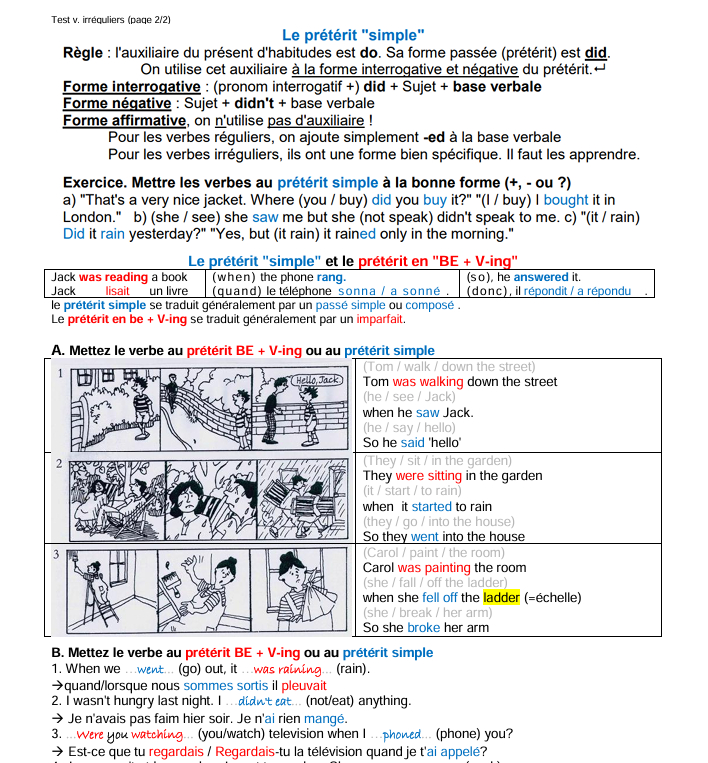
Sujet + was / were + verbe en -ING
SujetauxiliaireexempleI / he / she / itwasI was reading (je lisais)you / we / theywereThey were playing (ils jouaient)
🗣️ Exemples de phrases (avec traduction)
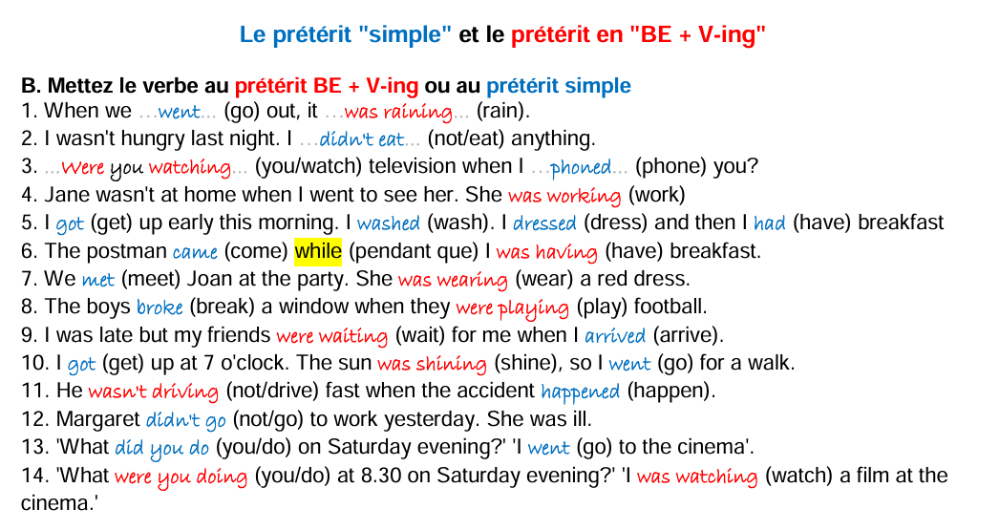
- I was watching TV when he called.
- 👉 Je regardais la télé quand il a appelé.
- They were sleeping during the storm.
- 👉 Ils dormaient pendant la tempête.
- What were you doing at 8pm?
- 👉 Que faisais-tu à 20h ?
- She wasn’t listening to the teacher.
- 👉 Elle n’écoutait pas le professeur.
🟨 3. Prétérit simple VS prétérit BE + V-ING
Prétérit simple 🟩
- Action courte, terminée
- "He opened the door."
- On sait quand
- Interruption
Prétérit BE + V-ING 🟦
- Action longue ou en cours
- "He was opening the door."
- On décrit un moment
- Action interrompue ou simultanée
💬 Ex :
🔸 I was walking in the street when I saw an accident.
👉 Je marchais dans la rue quand j’ai vu un accident.
🟥 4. Mots-clés utiles
🔹 Pour le prétérit simple :
- yesterday = hier
- last week = la semaine dernière
- in 2005 = en 2005
- two days ago = il y a deux jours
- then = ensuite
🔹 Pour le prétérit BE + V-ING :
- while = pendant que
- when = quand
- as = comme / pendant que
- at that moment = à ce moment-là
- all day = toute la journée