Keynes was a big critic of the classical theory of income and employment put forward by classical Economists. He out right rejected J.B Say's Law of market (Supply creates its own demand). He criticized Pigou's version that cuts in real wages help in promoting employment.
So, Keynes put forward his own take on income and employment in his book 'General Theory', suggesting that "In the short period, level of national income and so of employment is determined by aggregate demand and aggregate supply in the country. The equilibrium of national income occurs when aggregate demand = aggregate supply. This equilibrium is also called effective demand point"
Effective demand is determined by two factors, the aggregate supply function and the aggregate demand function. The aggregate supply function depends on physical or technical conditions of production which do not change in the short-run. Since Keynes assumes the aggregate supply function to be stable, he concentrates his entire attention upon the aggregate demand function to fight depression and unemployment. Thus employment depends on aggregate demand which in turn is determined by consumption demand and investment demand.
According to Keynes, employment can be increased by increasing consumption and/or investment. Consumption depends on income C(Y) and when income rises, consumption also rises but not as much as income. In other words, as income rises, saving rises. Consumption can be increased by raising the propensity to consume in order to increase income and employment. But the propensity to consume depends upon the psychology of the people, their tastes, habits, wants and the social structure which determine the distribution of income. All these elements remain constant during the short-run. Therefore, the propensity to consume is stable. Employment thus depends on investment and it varies in the same direction as the volume of investment.
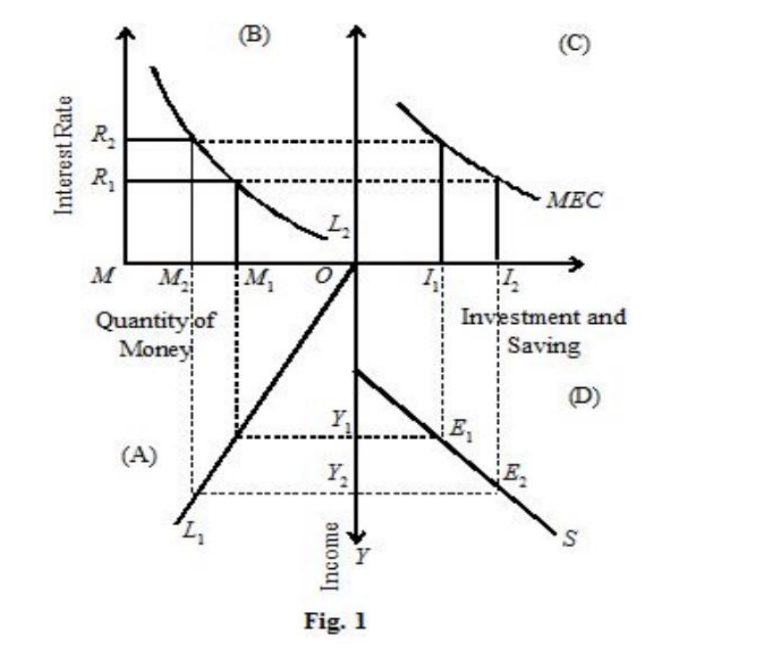
Investment, in turn, depends on the rate of interest and the marginal efficiency of capital (MEC). The MEC depends on the supply price of capital assets and their prospective yield. It can be raised when the supply price of capital assets falls or their prospective yield increases. Since the supply price of capital assets is stable in the short-run, it is difficult to lower it. The second determinant of MEC is the prospective yield of capital assets which depends on the expectations of yields on the part of businessmen. It is again a psychological factor which cannot be depended upon to increase the MEC to raise investment. Thus there is little scope for increasing investment by raising the MEC.