Partielo | Créer ta fiche de révision en ligne rapidement
College or University

Economics - Consumption function and it's determinants

The consumption function or propensity to consume refers to income-consumption relationship. IT is a "functional relationship between two aggregates", i.e. total consumption and national income. Symbolically the relationship is denoted as C = f(Y),

where c = consumption, y = income and f is the functional relationship. Thus the consumption function indicates a functional relationship between C and Y. where c is the dependent variable and Y is the independent variable. This relationship is based on the ceteris paribus assumption, as only income-consumption relationship is considered and all possible influences are held constant.
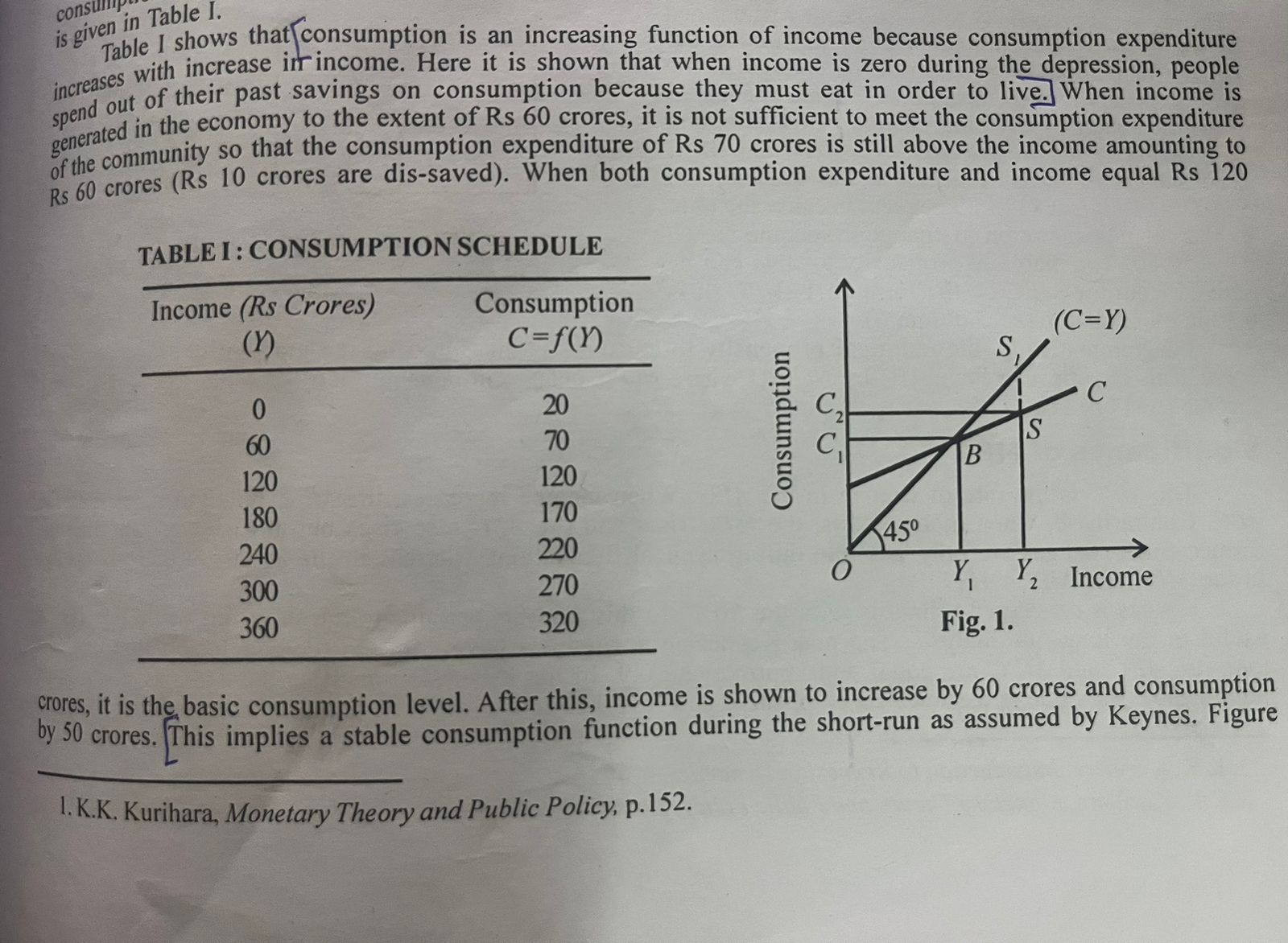


This table shows that consumption is an increasing function of income because consumption expenditure increases with increase in income. Here it is shown that when income is zero during depression, people still consume certain commodities.

This implies a stable consumption function during short rune as assumed by Keynes.


Technical attributes of consumption function : -

1) Average propensity to consume : -


The average propensity to consume may be defined as the ratio of consumption expenditure to any particular level of income. It is found by dividing consumption by income or APC = C/y. It is expressed as the percentage of income consumed. The APC declines as income increases because the proportion of income spent on consumption decreases.


2) Marginal Propensity to consume : -


It may be defined as the ratio of change in consumption to the change in come or as the rate of change in the average propensity to consume as income changes. It can be found by dividing change in consumption by a change in income. MPC = Change in C/ Change in Y.


Determinants of the consumption Function : -


1) Subjective Factors :-

Keynes subjective factors basically underlie and determine the form of the consumption function. Subjective factors are the psychological characteristics of human nature, social practices, etc.

A) Individual Motives : -

  • Desire to build reserves
  • Desire to provide for anticipated future needs
  • Desire to enjoy enlarged future income
  • Desire to enjoy a sense of independence
  • Desire to bequeath a fortune

B) Business motives :-

  • Enterprise, desire to do big things
  • Liquidity, desire to meet emergencies
  • Income raise, desire to secure large income
  • Financial Prudence, desire to provide financial resources against depreciation.


2) Objective Factors

  • Changes in wage level :-

If wage rate rises, consumption function moves upward, the workers having a high propensity to consume spend more out of their increased income.

  • Windfall Gains or losses:-

Unexpected changes in the stock market tends to shift the consumption function upward or downward

  • Changes in Fiscal policy :-

Changes in fiscal policy in the form of taxation from public expenditure affect the consumption function. Heavy commodity taxation adversely affect the consumption function by reducing disposable income of people.

  • Holding of liquid assets: -

The amount of liquid assets in the form of cash balances, savings and government bonds in the hands of consumers also influence the consumption function highly.

  • Changes in interest rates

substantial changes in the market rate of interest may influence the consumption function indirectly.



College or University

Economics - Consumption function and it's determinants

The consumption function or propensity to consume refers to income-consumption relationship. IT is a "functional relationship between two aggregates", i.e. total consumption and national income. Symbolically the relationship is denoted as C = f(Y),

where c = consumption, y = income and f is the functional relationship. Thus the consumption function indicates a functional relationship between C and Y. where c is the dependent variable and Y is the independent variable. This relationship is based on the ceteris paribus assumption, as only income-consumption relationship is considered and all possible influences are held constant.


This table shows that consumption is an increasing function of income because consumption expenditure increases with increase in income. Here it is shown that when income is zero during depression, people still consume certain commodities.

This implies a stable consumption function during short rune as assumed by Keynes.


Technical attributes of consumption function : -

1) Average propensity to consume : -


The average propensity to consume may be defined as the ratio of consumption expenditure to any particular level of income. It is found by dividing consumption by income or APC = C/y. It is expressed as the percentage of income consumed. The APC declines as income increases because the proportion of income spent on consumption decreases.


2) Marginal Propensity to consume : -


It may be defined as the ratio of change in consumption to the change in come or as the rate of change in the average propensity to consume as income changes. It can be found by dividing change in consumption by a change in income. MPC = Change in C/ Change in Y.


Determinants of the consumption Function : -


1) Subjective Factors :-

Keynes subjective factors basically underlie and determine the form of the consumption function. Subjective factors are the psychological characteristics of human nature, social practices, etc.

A) Individual Motives : -

  • Desire to build reserves
  • Desire to provide for anticipated future needs
  • Desire to enjoy enlarged future income
  • Desire to enjoy a sense of independence
  • Desire to bequeath a fortune

B) Business motives :-

  • Enterprise, desire to do big things
  • Liquidity, desire to meet emergencies
  • Income raise, desire to secure large income
  • Financial Prudence, desire to provide financial resources against depreciation.


2) Objective Factors

  • Changes in wage level :-

If wage rate rises, consumption function moves upward, the workers having a high propensity to consume spend more out of their increased income.

  • Windfall Gains or losses:-

Unexpected changes in the stock market tends to shift the consumption function upward or downward

  • Changes in Fiscal policy :-

Changes in fiscal policy in the form of taxation from public expenditure affect the consumption function. Heavy commodity taxation adversely affect the consumption function by reducing disposable income of people.

  • Holding of liquid assets: -

The amount of liquid assets in the form of cash balances, savings and government bonds in the hands of consumers also influence the consumption function highly.

  • Changes in interest rates

substantial changes in the market rate of interest may influence the consumption function indirectly.