Goold v. Collins [2005] 1 ILRM 1
- Hardiman J: "A case is moot if the passage of time has caused it to lose ‘its character as a present, live controversy".
- Courts will not exercise jurisdiction over moot cases unless exceptional circumstances justify doing so (e.g., issues of significant public importance).
- This case established the distinction between Locus Standi and Mootness:
- Standing assesses whether the dispute was validly initiated (requires an individual's personal interest in the matter challenged).
- Mootness focuses on whether the dispute remains live, meaning relevant during litigation.
The Borowski Principles: Borowski v. Canada (Attorney General) [1989] 1 SCR 342
The plaintiff challenged the constitutionality of Canadian abortion laws but during the proceedings, the laws in question were repealed, rendering the specific case moot.
- Even if an issue becomes moot for the parties involved in the specific case, a court may still address the matter if a decision could have meaningful effects on related or future proceedings.
- Some legal issues are important but keep becoming moot before they reach a final decision, however, courts may hear such cases to provide clarity for future similar disputes (e.g; Interlocutory injunctions (=a court order to compel or prevent a party from doing certain acts pending the final determination of the case) in industrial disputes often resolve before they can be fully reviewed, yet they may raise important legal questions).
- Courts must respect their role within the government, and therefore, the separation of powers, by avoiding to decide on hypothetical or abstract questions unless necessary.
Application of the principles: Lofinmakin v. Minister for Justice, Equality & Law Reform [2013]
- The applicants consisted of Nigerian nationals (parents) and their two Irish-born children (citizens).
- The Minister for Justice issued a deportation order against the father (the 3rd applicant) on immigration grounds which was challenged by the applicant on the basis that it violated their constitutional and EU law rights.
- Before the Supreme Court appeal, the CJEU decision in Zambrano (establishing derivative residency rights for EU citizens’ family members) was issued, so the minister revoked the deportation order against the father, granting him permission to reside in Ireland.
Judgment of the Supreme Court:
- The Court reaffirmed the definition of mootness from Goold v. Collins and Borowski under which a live dispute must exist at all stages of litigation, including the appeal.
- The revocation of the deportation order resolved the substantive legal dispute between the parties, therefore, the appeal was moot.
Legal Principles Established:
- A case is moot if events during litigation remove the basis for a legal dispute.
- Courts has discretion to address moot issues only under compelling circumstances, such as:
- Resolving recurring legal questions that evade review (Borowski).
- Issues of general public importance or systemic relevance (Odum).
- Denham CJ emphasized that using moot appeals to resolve cost disputes would undermine the doctrine’s purpose.
Odum v. Minister for Justice [2023] 2 ILRM 164
- The appellants also challenged a deportation order issued against the first appellant by the Minister for Justice.
- The case proceeded through the courts, and the Supreme Court granted leave to appeal, identifying issues of general public importance
- But the deportation order was revoked before the substantive hearing at the Supreme Court, therefore, the minister argued that the case was moot.
Judgment of the Supreme Court:
- The Court acknowledged that the revocation of the deportation order resolved the specific dispute between the parties.
- However, the legal issues underlying the appeal had implications for other cases, particularly on the general public importance of deportation law and procedural rights.
- The Court held that it had discretion to hear moot cases, especially under the Supreme Court’s constitutional role as the final arbiter of law
Distinction from Lofinmakin v. Minister for Justice [2013]
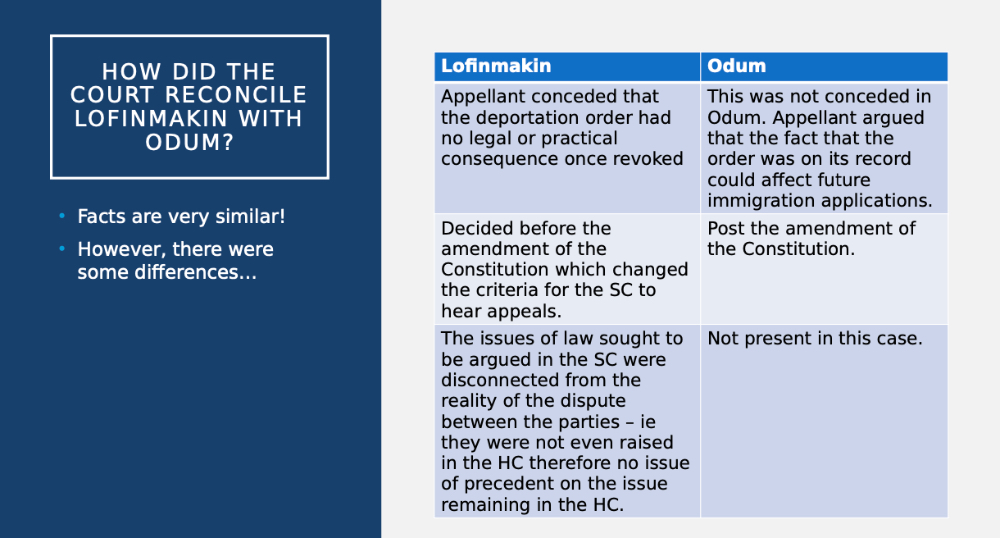
- In Lofinmakin, the Supreme Court declined to hear the appeal, finding no exceptional circumstances or broader legal implications - mootness was resolved strictly within the context of the dispute.
- In Odum, the Court departed from Lofinmakin, emphasizing the post-2014 constitutional amendments to the Supreme Court’s role:
- The SC emphasized its responsibility to address issues of general public importance or issues related tot the interests of justice even if the dispute is moot .
- Odum was deemed to meet these criteria, justifying a hearing despite mootness because the legal issues raised were not limited to the appellants but had broader implications for immigration law and deportation processes.
- The Court emphasized that mootness does not automatically bar an appeal from being heard if there are exceptional circumstances.
Judicial Discretion and Exceptions
Irwin v. Deasy [2013] IESC 49
- The Revenue Commissioners were judgment creditors of the husband, who owed significant debts and held three judgment mortgages over the husband's share in certain registered lands.
- During the appeal process, the husband’s debts were settled, potentially rendering the Revenue’s appeal moot.
- The Revenue argued that the legal issues raised were significant and had implications for other cases involving judgment mortgages.
This case established that Courts may proceed with a moot case in exceptional circumstances, particularly when:
- The issue has systemic or recurring significance.
- A party retains a material interest in the legal resolution (revenue stated this would have significant implications for other cases involving judgment mortgage).
- Addressing the issue would promote judicial economy and prevent future disputes.
Okunade v. Minister for Justice [2012] 3 IR 152
- The applicants, Nigerian nationals, sought judicial review of a deportation order issued by the Minister for Justice.
- While awaiting the judicial review, the applicants applied for a stay on the deportation order to remain in Ireland pending the outcome.
- The Supreme Court granted an early appeal but before the appeal was heard, the deportation order was effectively resolved, potentially rendering the case moot.
The Court emphasized its discretion to hear a moot appeal, particularly when the issue involves exceptional public importance or has recurring significance and judicial economy.
- The case involved legal questions who already arose in immigration matters and was likely to arise in many similar cases which was whether a stay should be granted pending judicial review of a deportation order.
- Hearing the case would provide clarity and avoid repetitive costly litigation on the same issue.
- The issue of granting stays in deportation cases involved balancing the constitutional rights of individuals (e.g., family life) which is a matter of public importance.
Kovacs v. Governor of Mountjoy Women’s Prison [2016] IECA 108
The Court relied on Lofinmakin and Borowski to outline the principles governing mootness and emphasized the following:
- The legal issue raised in Kovacs’ case was of significant public importance: because it concerned the legality of detaining individuals under multiple warrants for consecutive sentences which had broader implications for the criminal justice system and prison administration.
- The Court recognized the systemic relevance of ensuring clarity on the legality of detention procedures in concordance with Art. 40.4 Irish C, particularly in cases involving overlapping warrants.
- Therefore, addressing the issue in Kovacs’ case would avoid repeated challenges to detention procedures and provide legal certainty ensuring judicial economy.
- Although Kovacs was no longer detained, the interests of justice required the Court to address the legality of the High Court’s decision, which had implications beyond her case.
Kovacs v. Governor of Mountjoy Women’s Prison [2016] IECA 108
The Court relied on Lofinmakin and Borowski to outline the principles governing mootness and emphasized the following:
- The legal issue raised in Kovacs’ case was of significant public importance: because it concerned the legality of detaining individuals under multiple warrants for consecutive sentences which had broader implications for the criminal justice system and prison administration.
- The Court recognized the systemic relevance of ensuring clarity on the legality of detention procedures in concordance with Art. 40.4 Irish C, particularly in cases involving overlapping warrants.
- Therefore, addressing the issue in Kovacs’ case would avoid repeated challenges to detention procedures and provide legal certainty ensuring judicial economy.
- Although Kovacs was no longer detained, the interests of justice required the Court to address the legality of the High Court’s decision, which had implications beyond her case.