+ Atlantic Shellfish Ltd v Cork County Council [2015]: Lists the benefits of mediation as confidentiality, preserves relationships, reduces stress, allows choice of mediator/venue and is generally faster.
+ Lyons v. Financial Services Ombudsman [2011]: Court emphasized mediation as preferable over litigation.
+ Dunnett v Railtrack [2002]: Skilled mediators are now able to achieve results satisfactory to both parties in many cases, which isn't the case of lawyers and courts.
3. Confidentiality in Mediation
Section 10 of the 2017 Act: Communications and records in mediation are confidential and protected from disclosure in court, except in cases where disclosure is required by law, necessary to enforce a mediation settlement, necessary to prevent physical/psychological injury to a party or necessary to prevent threat to a party or crime.
Section 17 of the Mediation Act 2017 however outlines conditions under which a mediator must report to the court when mediation has occurred following a court invitation under Section 16(1) because the parties, having attempted mediation, apply to resume court proceedings.Report Content (Section 17(1)):
- The mediator’s report should include (S.17(1)):
= If Mediation Did Not Occur: A statement explaining the reasons why mediation did not take place.
= If Mediation Occurred: A statement indicating whether a settlement was reached and if a settlement was partially or fully achieved, a summary of the terms of the settlement.
The Mediator’s Institute of Ireland (MII) mandates confidentiality standards for all accredited mediators and participants through its Code of Ethics and Practice.
- Clause 81 – General Confidentiality: All mediation participants, including the mediator, parties, clients, and attendees, are bound by strict confidentiality.
- Clause 91 – Separate Meetings/Caucuses: Communications with the mediator in separate meetings, emails, or phone calls are confidential and cannot be shared with other parties unless explicit consent is provided.
- Clause 92 – Information for Clients (Non-Party): If a client (not a party) requires information, the mediator and parties must agree on what details may be shared.
- Clause 93 – Confidentiality of Inter-Party Communications: Any communication between the mediator and an individual party is kept private and will not be disclosed to the other party without consent.
4. Role of the Mediator
- Impartiality and Integrity (Section 8(2)): Mediators must treat parties fairly and complete the mediation as far as practicable while allowing parties to have sufficient time to consider issues and inform them of their right to each obtain independent advice prior to signing any mediation settlement.
- Mediator Proposals (Section 8(4)): Mediators can, at the request of the parties, make proposals to resolve the dispute, but acceptance is entirely up to the parties.
- Withdrawal (Section 6(4)): The mediator may withdraw at any time during the mediation by writing a notice given to the parties stating the general reasons for the withdrawal.
5. Enforceability of Mediation Settlements
Section 11 of the Mediation Act 2017:
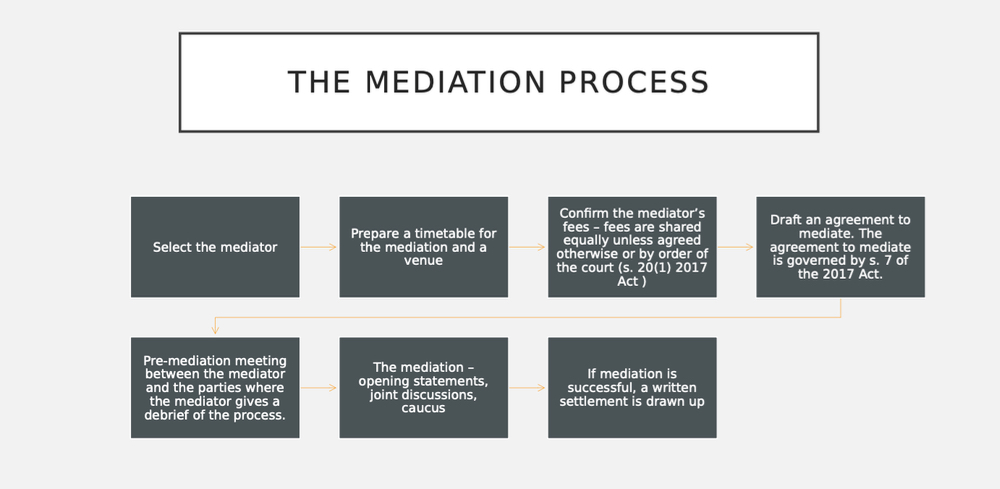
- The parties themselves decide when a mediation settlement has been reached and whether it will be legally enforceable (Section 11(1)).
- Unless stated otherwise, a mediation settlement shall have effect as a contract between the parties (Section 11(2)).
- A court may enforce a mediation settlement upon a party’s request, except (Section 11(3)) :
= If the settlement fails to adequately protect the parties' rights and entitlements.
= If the agreement is not based on full and mutual disclosure of assets.
= If enforcing the settlement would violate public policy.
= If one party was pressured or unduly influenced by the other in reaching the agreement.
6. Mandatory Mediation Advice by Solicitors
Section 14 of the Mediation Act 2017: Solicitors in practice must inform clients of the option and benefits of mediation as an alternative to court proceedings.
+ In Byrne & Ors v Arnold [2024], the Irish High Court examined the consequences for solicitors who fail to comply with Section 14 of the Mediation Act 2017, which requires solicitors to advise clients on the option of mediation before initiating litigation.
- The court clarified that solicitors are not obligated to push clients towards mediation but must provide an informed and balanced assessment explaining the potential benefits of mediation based on the client’s unique circumstances and that, before filling any lawsuit.
- If not complied with, court proceedings may be adjourned to allow the solicitor to fulfill this requirement => the court noted that in this instance, latitude was granted by adjourning proceedings to allow the solicitor to meet Section 14 requirements but stated that she may not be so lenient in future cases.
- Non-compliance can lead to cost penalties, as seen in the court's use of Section 169 of the Legal Services Regulation Act 2015, = in this case, the court reduced the plaintiff award by 5% due to the solicitor’s failure to comply with S.14.
- S.14 serves the public interest by encouraging parties to explore alternatives to litigation, potentially reducing unnecessary court cases and avoiding prolonged litigation.
7. Court’s Power to Encourage Mediation
Section 16 of the Mediation Act 2017: Empowers Irish courts to encourage parties to consider mediation as an alternative dispute resolution (ADR) mechanism, before and even after court proceedings have commenced.
- This invitation to mediate, initiated by the court's own initiative or upon request of one of the parties, will be considered appropriate based on the specific circumstances of the case, such as the nature of the dispute, the relationship between the parties, and the potential for a mutually beneficial resolution.
Actions the Court May Take Following an Invitation (Section 16(2)):
- The court has the authority to adjourn the case temporarily to allow the parties to pursue mediation.
- The court may extend deadlines for procedural requirements (e.g. filing pleadings or other court documents) to accommodate the mediation process.
+ Atlantic Shellfish Ltd v Cork County Council [2015], reinforces the principle that courts can encourage but not compel mediation in disputes where it is deemed suitable - however, where cases involve complex legal matters or require judicial clarity, the court may find mediation inappropriate.
- Atlantic Shellfish Ltd, an oyster fishery business, alleged that its oyster beds were contaminated due to sewage discharge near its operation site and claimed damages from the defendants, including Cork County Council and the State.
- Atlantic Shellfish Ltd requested mediation to settle the dispute, which the State defendants opposed, arguing that the matter was too complex for mediation and should be resolved in court.
- The High Court refused to compel mediation under Order 56A, which allows courts to adjourn proceedings to facilitate ADR when deemed appropriate.
- The Court of Appeal upheld the High Court's decision, ruling that the court cannot compel parties to mediate in complex cases where it is unlikely to resolve or even narrow the issues given the complexities and the requirement for judicial clarity on legal obligations surrounding environmental licensing and duty of care.
Therefore, the decision to encourage or adjourn proceedings for ADR under Order 56A (or under the subsequent Section 16 of the Mediation Act 2017) is highly discretionary as Courts have to evaluate complexity and suitability for mediation and efficiency and likelihood of issue resolution.
+ In Searson v Dublin City Council & Ors [2020], the Irish High Court addressed the scope of judicial discretion in issuing formal invitations for mediation under Section 16 of the Mediation Act 2017.
- The case involved a long-standing dispute between Mr. Searson, a tenant, and Dublin City Council who conducted defective repair work leaving Searson's home in uninhabitable conditions, leading to significant stress and anxiety.
- Mediation Attempts: Before initiating the court proceedings, the parties had engaged in mediation without reaching a final resolution, therefore, during court proceedings, DCC suggested re-engaging in mediation but Searson declined.
- The High Court exercised its discretion under Section 16 of the Mediation Act 2017 to formally invite Searson to consider mediation once more, emphasizing that while it could encourage or invite mediation, it could not compel a party to mediate if they were unwilling.
- The court noted that mediation could potentially resolve the dispute in a more efficient and less adversarial way, especially given the emotional distress the plaintiff had experienced.
- Although the court expressed a preference for ADR, it respected Searson's decision to decline mediation, underscoring the principle of voluntary participation in mediation under the Mediation Act 2017.
8. Costs Implications for Refusal to Mediate
Section 21 of the Mediation Act 2017: Court may consider a party’s unreasonable refusal to mediate when awarding costs and therefore lower the cost award.
+ IEGP Management Co. Ltd v. Cosgrave [2023] further refined the principles regarding the costs implications of refusing to mediate and established guidance on when courts should exercise their discretion to encourage or invite mediation.
- One of the defendants in the case refused to participate in mediation, arguing that the case was unsuitable for ADR due to the complexity and scope of issues involved.
- The High Court initially refused to invite mediation, finding that the claims against the defendant were vague and that mediation at this stage was premature.
- The Court of Appeal upheld the High Court's decision, agreeing that the case was not suitable for mediation at that time due to the generic and undifferentiated nature of the claims and clarified that while ADR can be an effective tool for resolving disputes, mediation is appropriate only when issues are clearly defined and there is a realistic prospect of settling or narrowing disputes through the process.
- The decision to invite mediation is a discretionary matter for the trial judge and mediation requires clear/ defined issues and a realistic prospect that it could either resolve the dispute or significantly narrow the issues in contention.
- This case demonstrates that cost penalties are not automatic and the court considers each refusal based on context - here, the refusal was not penalized with costs implications because it was deemed reasonable given the litigation’s premature stage and the lack of clarity in the issues.