Partielo | Créer ta fiche de révision en ligne rapidement

Chapter 4: Selections (Conditional Statements)

Définition

Selections
Selections are conditional statements used to execute specific blocks of code based on whether conditions are met. These conditions evaluate to True or False. With conditional selection, the program decides which block of code to execute at runtime. Selections use if, if-else, and elif statements.

The if Statement

  • Used to test a condition.
  • If the condition is True, the indented block of code executes.
  • If the condition is False, the block is skipped.

Syntax:

if condition:
    # Code executes if condition is True

Example:

age = 20
if age >= 18:
    print("You are an adult.")

Important Note:

  • Indentation is crucial in Python.
  • Statements with the same indentation belong to the same block.
  • Different indentation levels define separate blocks.


The if-else Statement

  • Adds an alternative block when the condition is False.

Syntax:

if condition:
    # Code executes if condition is True
else:
    # Code executes if condition is False

Example:

age = 16
if age >= 18:
    print("You are an adult.")
else:
    print("You are a minor.")


The elif Statement

  • Used when there are multiple conditions.
  • Executes the first True condition and skips the rest.

Syntax:

if condition1:
    # Code executes if condition1 is True
elif condition2:
    # Code executes if condition1 is False and condition2 is True
else:
    # Code executes if all conditions are False

Example:

age = 14
if age < 13:
    print("Child")
elif age < 18:
    print("Teenager")
else:
    print("Adult")


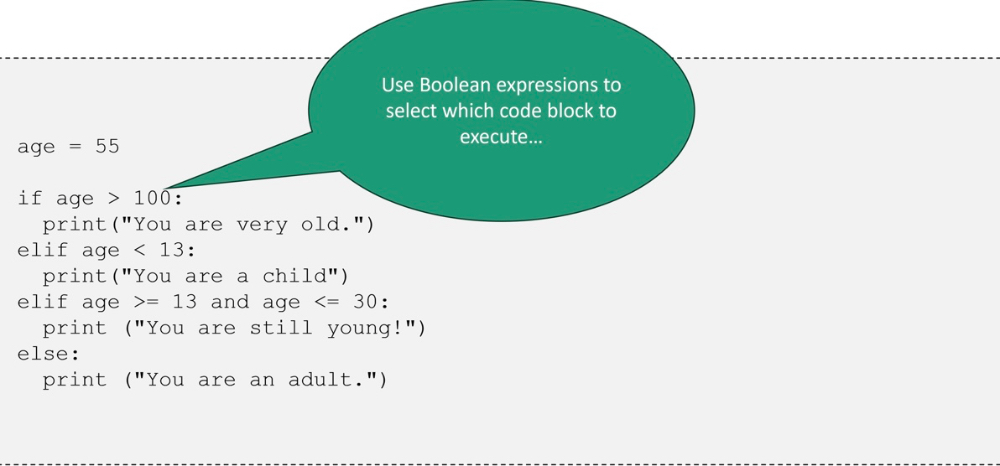
Boolean Expressions and Conditional Execution

Boolean Expressions:

  • A Boolean expression evaluates to True or False.
  • Used in ifif-else, and elif statements.

Relational Operators:

OperatorMeaning>Greater than<Less than>=Greater than or equal to<=Less than or equal to==Equal to!=Not equal to

Logical Operators:

OperatorMeaningandBoth conditions must be TrueorAt least one condition must be TruenotNegates a condition

Example with Boolean Expressions:

x = 10
y = 5

if x > y and y > 0:
    print("Both conditions are True")



Chapter 4: Selections (Conditional Statements)

Définition

Selections
Selections are conditional statements used to execute specific blocks of code based on whether conditions are met. These conditions evaluate to True or False. With conditional selection, the program decides which block of code to execute at runtime. Selections use if, if-else, and elif statements.

The if Statement

  • Used to test a condition.
  • If the condition is True, the indented block of code executes.
  • If the condition is False, the block is skipped.

Syntax:

if condition:
    # Code executes if condition is True

Example:

age = 20
if age >= 18:
    print("You are an adult.")

Important Note:

  • Indentation is crucial in Python.
  • Statements with the same indentation belong to the same block.
  • Different indentation levels define separate blocks.


The if-else Statement

  • Adds an alternative block when the condition is False.

Syntax:

if condition:
    # Code executes if condition is True
else:
    # Code executes if condition is False

Example:

age = 16
if age >= 18:
    print("You are an adult.")
else:
    print("You are a minor.")


The elif Statement

  • Used when there are multiple conditions.
  • Executes the first True condition and skips the rest.

Syntax:

if condition1:
    # Code executes if condition1 is True
elif condition2:
    # Code executes if condition1 is False and condition2 is True
else:
    # Code executes if all conditions are False

Example:

age = 14
if age < 13:
    print("Child")
elif age < 18:
    print("Teenager")
else:
    print("Adult")


Boolean Expressions and Conditional Execution

Boolean Expressions:

  • A Boolean expression evaluates to True or False.
  • Used in ifif-else, and elif statements.

Relational Operators:

OperatorMeaning>Greater than<Less than>=Greater than or equal to<=Less than or equal to==Equal to!=Not equal to

Logical Operators:

OperatorMeaningandBoth conditions must be TrueorAt least one condition must be TruenotNegates a condition

Example with Boolean Expressions:

x = 10
y = 5

if x > y and y > 0:
    print("Both conditions are True")