
An affine function is represented by the function f(x)=ax+b
a=slope b=y-intercept
Method 1:
To draw a straight line representing a given affine function, we use a table of values
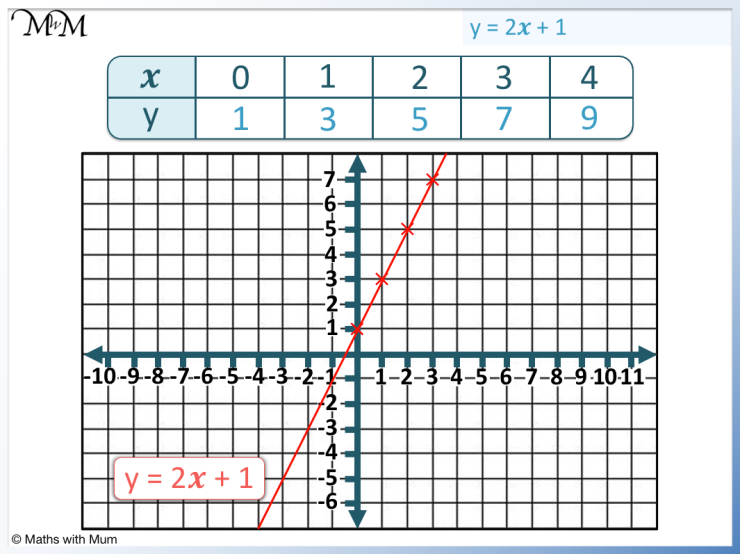
Method 2:How to draw the line representing an affine function from its slope and y-intercept.
We place the y-intercept first and use the slope to make a triangle of vertical and horizontal progress to get a second
Method 3: how to determine if a point is on a line or not
The co-ordinates must verify the equation for the point to be on the line.
Method 4: how to determine the algebraic expression of an affine function from the co-ordinates of two points on the line representing it.
We use formulae to calculate the slope a and y-intercept b using the coordinates
Example 4
Determine the algebraic expression f(x) of the function represented by the line (AB), where A(-2; - 1) and B(1; 5).
Since a line represents an affine function, then f is affine.
Since f is affine then f(x)=ax+b where a=yb-ya/xb-xa=5-(-1)/1-(-2)=6/3=2
and b=ya -axA=-1+4=3
Conclusion: f(x) = 2x + 3
Method 5: how to determine the point of intersection of a line with the axes
The y-intercept b of the expression f(x) = ax + b is the point of intersection of the line d and the y-axis. That is
immediate if we have the expression f(x) = ax + b.
To fine the point of intersection of d and the x-axis, we sole the equation f(x) = 0.
Method 6: how to determine the intersection of two lines on the plane, given their equations
- Two given lines may be strictly parallel, in which case there is no intersection.
- Two given lines may be superposed, le. they are the same line. The intersection is the infinite set of points on the line.
- Two lines may be secant: the intersection is a unique point.
We rearrange the equations of the lines so that they are both in the form y = ax + b,
and compare the slopes a and y intercepts b:
Therefore in a system Y = ax + b
y = ax + b represented by a pair of lines:
- If a = a'but b a b' then the lines are strictly parallel and there is no solution to the system.
- Ifa = a and b = b' then the lines are superposed and there is an infinity of solutions to the system.
- If a a' then the lines of these equations are not parallel and there is one point of intersection and one couple solution of the system.
Linear combinations method
x=3
y=7
The system
[y = 3x - 2
ly = 2x + 7 is equivalent to
-
0 = x-3
y = 2x + 1
(by subtracting line 2 from line 1 to get a new line 1)
x = 3
ly = 2x3 + 1
(by substituting 3 for x in the second line)