
Monosaccharides are monomers. Two monosaccharides can react together in a condensation reaction to produce a disaccharide. One or more disaccharides joined together forms a polysaccharide.
Monomers and Polymers
Definitions
Monomer
Smaller units from which larger molecules are made
Polymer
Molecules made from a large number of monomers
joined together
Condensation reaction
A reaction that joins two molecules together with the formation of a chemical bond and involves the elimination of a water molecule
Hydrolysis reaction
A reaction that breaks a chemical bond between two molecules using a water molecule
Carbohydrates
- Glucose + Glucose → Maltose
- Glucose + Fructose → Sucrose
- Glucose + Galactose → Lactose
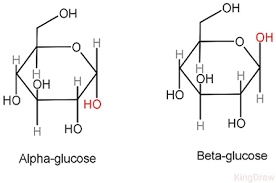
Glucose Isomers
Glycogen, Starch and Cellulose
Glycogen and starch are polymers of a glucose, whilst cellulose is a polymer of b glucose
Starch structure and function
- Polymer of a a glucose
- 1-4 glycosidic bonds
- Has a very coiled structure - lots of energy stored in a small area
- Very large - so cannot move in/out of cell
- Insoluble - so doesn't affect water potential
- Highly branched - lots of ends for enzymes to act on to release energy quickly
Cellulose structure and function
- Long straight chains of b glucose formed by glycosidic bonds
- Many weak hydrogen bonds between chains - together provide strength and rigidity between chain
- Joined chains form fibrils which make up plant cell walls
Glycogen structure and function
- Polymer of a glucose with 1-6 glycosidic bonds
- Highly branched - lots of ends for enzymes to act on to release energy quickly
- Less dense and more soluble than starch - broken down quicker as animals are more metabollically active
Test for reducing sugars
- Add sample to a test tube (grind up sample and add distilled water if it is not a liquid)
- Add 2cm3 of benedict's solution
- Repeat for all samples
- Prepare water bath, heat test tubes in water bath for 5 minutes
- Red/yellow/green precipitate indicates reducing sugar present
Test for non-reducing sugars
- Add dilute HCl to sample and heat in a water bath that has been brought to the boil (breaks glycosidic bond)
- Neutralise sample with Sodium Hydrogencarbonate
- Remaining monosaccharides have a ketone/aldehyde group so can donate electrons
- Carry out Benedict's tests normal