Partielo | Créer ta fiche de révision en ligne rapidement
Post-Bac
1

Management

Management

Définition

organizations
Organization is a system which operates through human activity. Organization Theories concerns 3 levels: - Macro: cooperation among different organizations - Mezzo: structures of the organizations, and influencing factors - Micro: behavior of the members of the organizations, motivation, conflict etc. Definition: organizations are (1) social entities that (2) are goal-directed, (3) are designed as deliberately structured and coordinated activity systems, and (4) linked to the external environment.
  • Bring together resources to achieve desired goals and outcomes
  • Produce goods and services efficiently
  • Create value for owners, customers and employees


Challenges:

  • Facilitate innovation
  • Use modern manufacturing and information technologies
  • Adapt to and influence a changing environment
  • Accommodate ongoing challenges of diversity, ethics, and the motivation and coordination of employees


Organizations define their objectives based on their Vision, and their Mission.

Vision :

- the optimal desired future state

- the mental picture of what an organization wants to achieve over time;

- Inspirational

- Future guideline


Mission :

- Defines the present state or purpose of an organization;

- WHY an organization exists - WHAT it does; WHO it does it for; and HOW it does what it does.

- a sentence or two, but for a shorter timeframe than a Vision statement
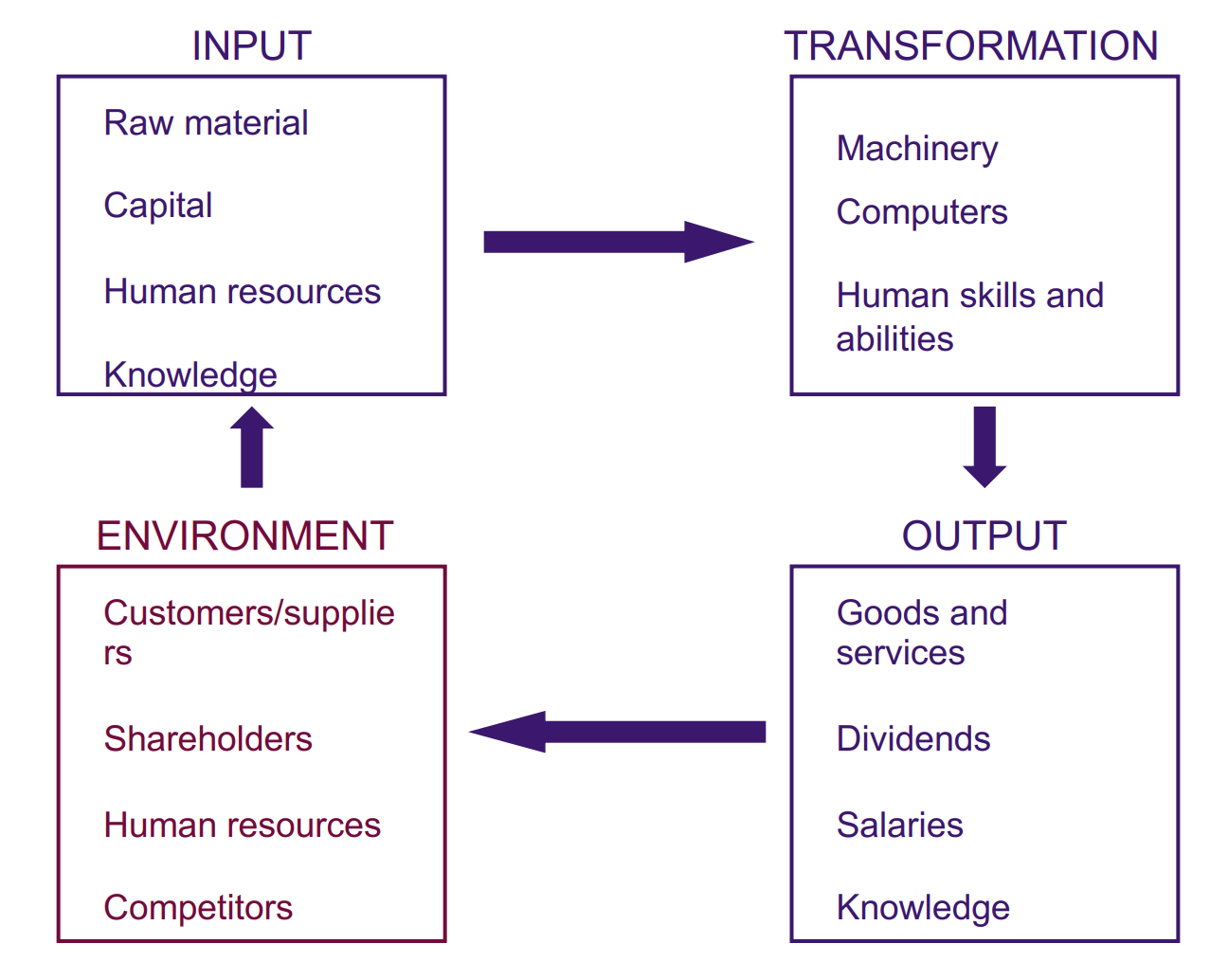

Value creation

Définition

Management
Management is the attainment of organizational goals in an effective and efficient manner through planning, organizing, directing and controlling organizational resources.

A retenir :

Efficiency : is getting the work done with a minimum of effort, expense, or waste.

Effectiveness : is completing activities so that the organization’ s goals are attained.


DIFFERENT TYPES OF MANAGEMENT

Scientific Management : Taylor

» Putting the right person on the job with the correct tools and equipment.

» Having a standardized method of doing the job.

» Providing an economic incentive to the worker. 


A retenir :

4 taylorism principles :

  • Develop a science for each element of a man’s work, which replaces the old rule-of-thumb method.
  • Scientifically select and then train, teach, and develop the workman. 
  • Cooperate with the men to insure all work is done in accordance with the principles of the science.
  • There is almost equal division of the work and the responsibility between management and workmen.


critics of taylorism :

  • Alienation of human beings.
  • Loss of craftsman knowledge.
  • Strong control system: disciplinary society (Foucault) “technique in order to make useful individuals”
  • What about heterogeneity of individuals?
  • Double movement: Individual disappear but every work performance has to be calculated in an individual basis.


General Administrative : Fayol

• Believed that the practice of management was distinct from other organizational functions.

• Developed principles of management that applied to all organizational situations.


The aim of bureaucracy :

1. Qualification-based hiring

2. Merit-based promotion

3. Chain of command

4. Division of labor

5. Impartial application of rules and procedures

6. Recorded in writing

7. Managers separate from owners


Quantitative Approach :

• Also called operations research or management science.

• Evolved from mathematical and statistical methods developed to solve WWII military logistics and quality control problems.

• Focuses on improving managerial decision making by applying:

  • statistics § optimization models
  • information models
  • computer simulations


Behavioral Appproach : Elton Mayo

The study of the actions (behaviors) of people at work; people are the most important asset of an organization. Productivity unexpectedly increased under imposed adverse working conditions.

Social norms, group standards and attitudes more strongly influence individual output and work behavior than do monetary incentives.


Contemporary Approach :

  • Systems approach : A set of interrelated and interdependent parts arranged in a manner that produces a unified whole.
  • Closed system : Are not influenced by and do not interact with their environment (all system input and output is internal).
  • Open system : Dynamically interact to their environments by taking in inputs and transforming them into outputs that are distributed into their environments.
  • Contingency approach : Holds that the most effective management theory or idea depends on the kinds of problems or situations that managers are facing at a particular time and place.


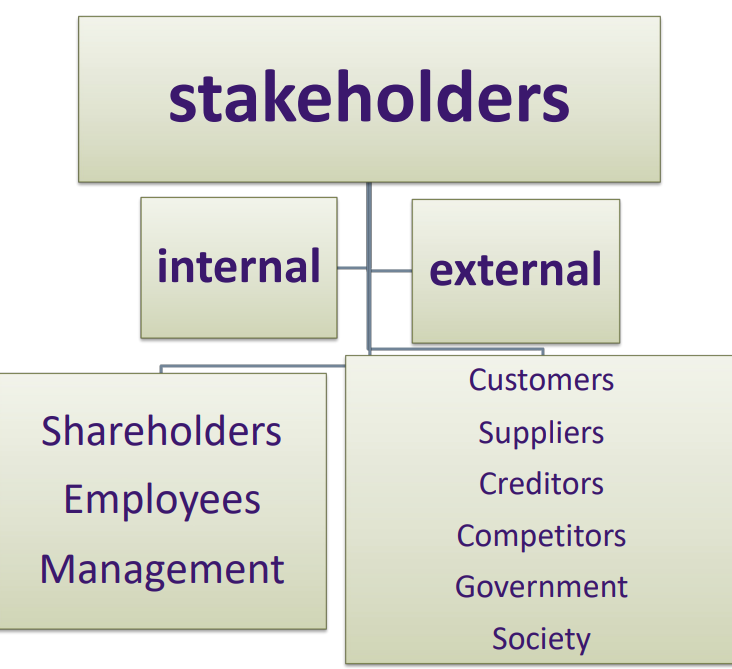
STAKEHOLDERS


Définition

stakeholder
individuals and constituencies that contribute, either voluntarily or involuntarily, to its wealth-creating capacity and activities and who are therefore its potential beneficiaries and risk takers.
Shareholder
Managers have a fiduciary relationship to the owners to look after their interests.

Case Study : FAVI

1)  Define Favi as an organization, considering the 4 main characteristics of an organization.

An organization like Favi:

• is a social entity : it has a social dimension, in the sense of interactions between groups and individuals

• has objectives : it aims to satisfy the customer and generate profits

• is designed to divide and coordinate work : it combines different modes of division and coordination of work

• is linked to its environment : it works closely with customers, it has suppliers (not seen in the film) and it is very well established in its small provincial town as well as internationalized because customers are all over the world 


2) Which one of the taylor principles do you recognise in FAVI ?

• Standardization of working methods

• Compensation is correlated to performance through bonuses and incentives


3) Which Fayol's principles in FAVI?

Management is separate from the owners.

  • Zobrist is an employee of the organization who reports to the owners.

Control, Order and Discipline, Merit-based Promotion

  • Rules are applied to everyone
  • The control is an internal process (in the group, collective)
  • there are leaders who are managers, and a quality department external to the units that controls the conformity of the parts.


4) Which principles of the school of human relations in FAVI?

The principles of the School of Human Relations are at the heart of Zobrist's management philosophy:

  • He is very present and pays attention to the employees
  • Leaders are very present and pay attention to employees.
  • Group norms are a very important management tool.
  • Well-being of the employees is being considered by the organization.
  • Very strong culture


5) To what extent can we speak of contingency in FAVI?

  • Contingency is then presented as a universal recipe.
  • In Favi we adapt to each customer, and we adapt to work by the suggestions of the workers. 


Organisation Structure

Définition

Strategy
Executives need to develop a set of complex tactics and activities that lead to a VICTORY. It is a plan for interacting with the competitive environment.
Organisation design
set of choices regarding the allocation and combination of resources and activities. It has 3 goals : - Strategic goal - Production goal - Societal goal

Organisation chart :

  • how activities are allocated to organizational units (boxes)
  • what are the reporting relationships among units (lines)
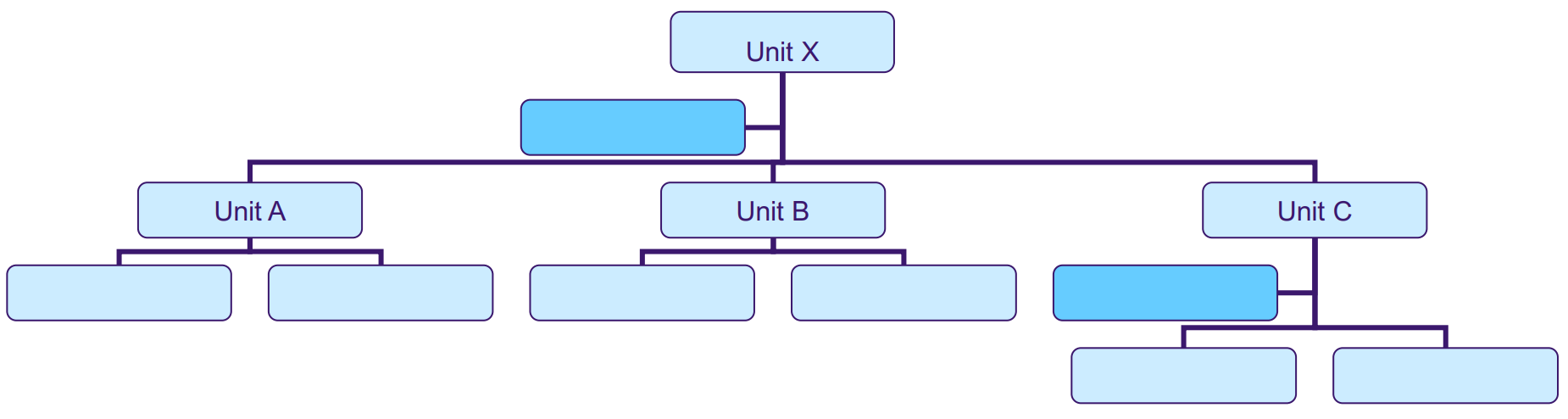
Organisation Chart

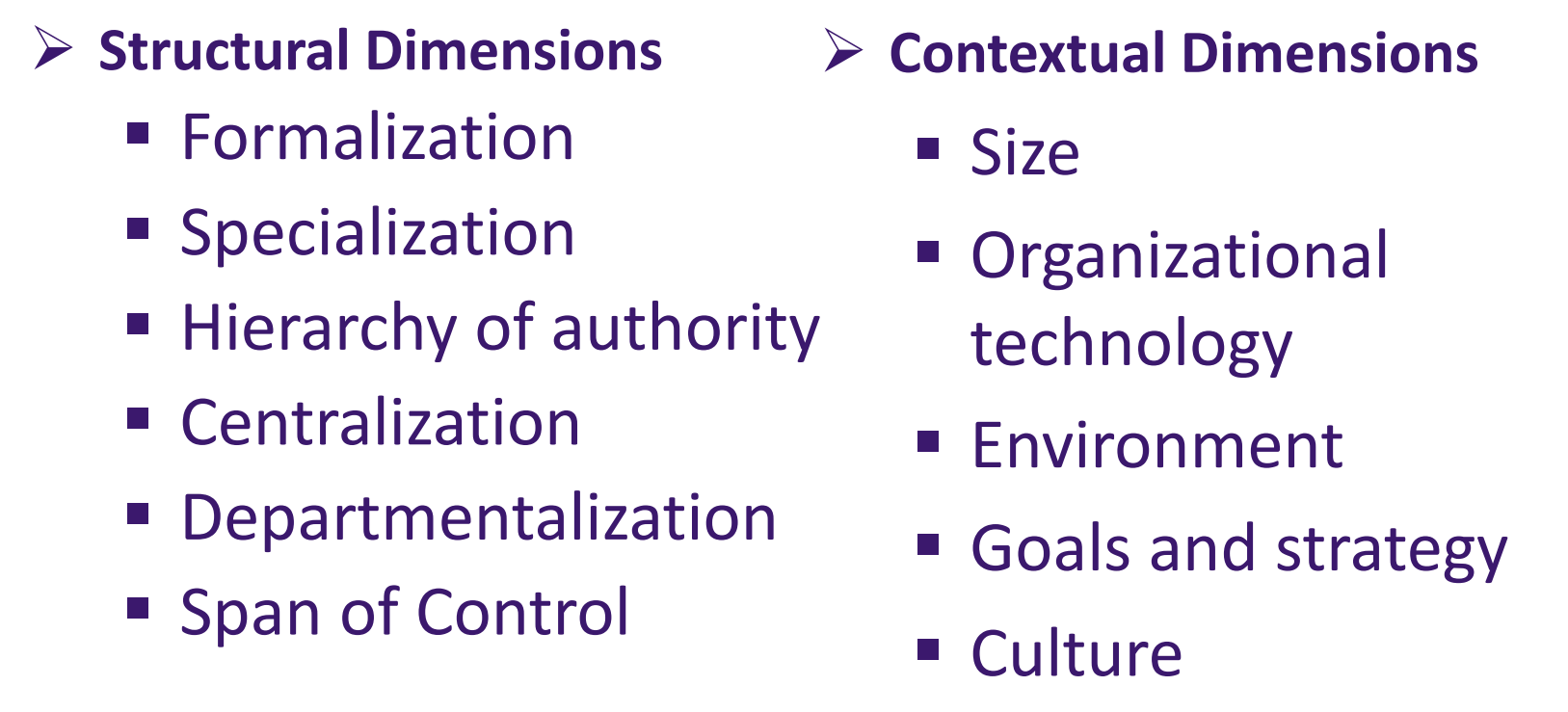
Dimensions of organization design :


Définition

Degree of formalization
high : explicit job description, lots of organizational rilles, defind procedure low : non-programmed jobs behaviors, discretion in task development.
Specialization
the degree to which organizational tasks are subdivided into seperate jobs
hierarchy
continuous line of command that extend from the top to the bottom and define the layers of responsibilty
Centralization
the center/top management makes decision with little or no input from the lower personnel
Decentralization
lower levels can make decisions
Span of control
Number of employees a manager can effectively manage
Departmentalization
Division of labor based on the grouping of skills or resources of the same type, which leads to the creation of group units.

Post-Bac
1

Management

Management

Définition

organizations
Organization is a system which operates through human activity. Organization Theories concerns 3 levels: - Macro: cooperation among different organizations - Mezzo: structures of the organizations, and influencing factors - Micro: behavior of the members of the organizations, motivation, conflict etc. Definition: organizations are (1) social entities that (2) are goal-directed, (3) are designed as deliberately structured and coordinated activity systems, and (4) linked to the external environment.
  • Bring together resources to achieve desired goals and outcomes
  • Produce goods and services efficiently
  • Create value for owners, customers and employees


Challenges:

  • Facilitate innovation
  • Use modern manufacturing and information technologies
  • Adapt to and influence a changing environment
  • Accommodate ongoing challenges of diversity, ethics, and the motivation and coordination of employees


Organizations define their objectives based on their Vision, and their Mission.

Vision :

- the optimal desired future state

- the mental picture of what an organization wants to achieve over time;

- Inspirational

- Future guideline


Mission :

- Defines the present state or purpose of an organization;

- WHY an organization exists - WHAT it does; WHO it does it for; and HOW it does what it does.

- a sentence or two, but for a shorter timeframe than a Vision statement


Value creation

Définition

Management
Management is the attainment of organizational goals in an effective and efficient manner through planning, organizing, directing and controlling organizational resources.

A retenir :

Efficiency : is getting the work done with a minimum of effort, expense, or waste.

Effectiveness : is completing activities so that the organization’ s goals are attained.


DIFFERENT TYPES OF MANAGEMENT

Scientific Management : Taylor

» Putting the right person on the job with the correct tools and equipment.

» Having a standardized method of doing the job.

» Providing an economic incentive to the worker. 


A retenir :

4 taylorism principles :

  • Develop a science for each element of a man’s work, which replaces the old rule-of-thumb method.
  • Scientifically select and then train, teach, and develop the workman. 
  • Cooperate with the men to insure all work is done in accordance with the principles of the science.
  • There is almost equal division of the work and the responsibility between management and workmen.


critics of taylorism :

  • Alienation of human beings.
  • Loss of craftsman knowledge.
  • Strong control system: disciplinary society (Foucault) “technique in order to make useful individuals”
  • What about heterogeneity of individuals?
  • Double movement: Individual disappear but every work performance has to be calculated in an individual basis.


General Administrative : Fayol

• Believed that the practice of management was distinct from other organizational functions.

• Developed principles of management that applied to all organizational situations.


The aim of bureaucracy :

1. Qualification-based hiring

2. Merit-based promotion

3. Chain of command

4. Division of labor

5. Impartial application of rules and procedures

6. Recorded in writing

7. Managers separate from owners


Quantitative Approach :

• Also called operations research or management science.

• Evolved from mathematical and statistical methods developed to solve WWII military logistics and quality control problems.

• Focuses on improving managerial decision making by applying:

  • statistics § optimization models
  • information models
  • computer simulations


Behavioral Appproach : Elton Mayo

The study of the actions (behaviors) of people at work; people are the most important asset of an organization. Productivity unexpectedly increased under imposed adverse working conditions.

Social norms, group standards and attitudes more strongly influence individual output and work behavior than do monetary incentives.


Contemporary Approach :

  • Systems approach : A set of interrelated and interdependent parts arranged in a manner that produces a unified whole.
  • Closed system : Are not influenced by and do not interact with their environment (all system input and output is internal).
  • Open system : Dynamically interact to their environments by taking in inputs and transforming them into outputs that are distributed into their environments.
  • Contingency approach : Holds that the most effective management theory or idea depends on the kinds of problems or situations that managers are facing at a particular time and place.


STAKEHOLDERS


Définition

stakeholder
individuals and constituencies that contribute, either voluntarily or involuntarily, to its wealth-creating capacity and activities and who are therefore its potential beneficiaries and risk takers.
Shareholder
Managers have a fiduciary relationship to the owners to look after their interests.

Case Study : FAVI

1)  Define Favi as an organization, considering the 4 main characteristics of an organization.

An organization like Favi:

• is a social entity : it has a social dimension, in the sense of interactions between groups and individuals

• has objectives : it aims to satisfy the customer and generate profits

• is designed to divide and coordinate work : it combines different modes of division and coordination of work

• is linked to its environment : it works closely with customers, it has suppliers (not seen in the film) and it is very well established in its small provincial town as well as internationalized because customers are all over the world 


2) Which one of the taylor principles do you recognise in FAVI ?

• Standardization of working methods

• Compensation is correlated to performance through bonuses and incentives


3) Which Fayol's principles in FAVI?

Management is separate from the owners.

  • Zobrist is an employee of the organization who reports to the owners.

Control, Order and Discipline, Merit-based Promotion

  • Rules are applied to everyone
  • The control is an internal process (in the group, collective)
  • there are leaders who are managers, and a quality department external to the units that controls the conformity of the parts.


4) Which principles of the school of human relations in FAVI?

The principles of the School of Human Relations are at the heart of Zobrist's management philosophy:

  • He is very present and pays attention to the employees
  • Leaders are very present and pay attention to employees.
  • Group norms are a very important management tool.
  • Well-being of the employees is being considered by the organization.
  • Very strong culture


5) To what extent can we speak of contingency in FAVI?

  • Contingency is then presented as a universal recipe.
  • In Favi we adapt to each customer, and we adapt to work by the suggestions of the workers. 


Organisation Structure

Définition

Strategy
Executives need to develop a set of complex tactics and activities that lead to a VICTORY. It is a plan for interacting with the competitive environment.
Organisation design
set of choices regarding the allocation and combination of resources and activities. It has 3 goals : - Strategic goal - Production goal - Societal goal

Organisation chart :

  • how activities are allocated to organizational units (boxes)
  • what are the reporting relationships among units (lines)

Organisation Chart

Dimensions of organization design :


Définition

Degree of formalization
high : explicit job description, lots of organizational rilles, defind procedure low : non-programmed jobs behaviors, discretion in task development.
Specialization
the degree to which organizational tasks are subdivided into seperate jobs
hierarchy
continuous line of command that extend from the top to the bottom and define the layers of responsibilty
Centralization
the center/top management makes decision with little or no input from the lower personnel
Decentralization
lower levels can make decisions
Span of control
Number of employees a manager can effectively manage
Departmentalization
Division of labor based on the grouping of skills or resources of the same type, which leads to the creation of group units.