two players (or +):
political/economical actors (countries or individuals)
a set of strategies (2 choices or +) for each player
both player can choose the same strategy
combination of strategies leaves a possible outcome
outcomes bring different payoffs (gains)
=>preference over possible outcomes
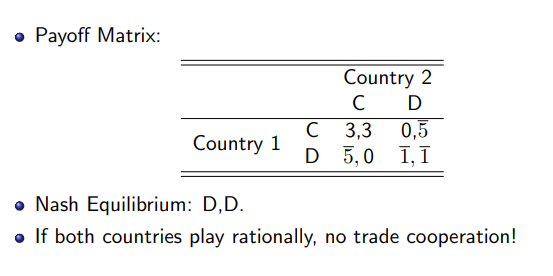
defect: maintaining high tarifs
non cooperative game
players keep their strategy unchanged
a player does not gain from deviating from their inital strategy
Nash equilibrium:
best response to each other strategy, to maximum the payoffs: always defection =>ends up in protectionism
=>reality of trade: countries will always maintain their tariff in the hope that other countries will lower them (C)
=>avoid foreign competition + export goods
An outcome is pareto efficiency if there is no other outcome that increases one players payoff without decreasing anyone elses
Characteristics:
Play only once
Simultaneity: cannot predict what the other player is gonna do
no communication
no way to enforce cooperation
problems: if players play rationnally (=D;D): no benefit
=>loose out of no trade cooperation:
lot of protectionism lowers the number of consumers
How can we achieve cooperation in a PD scenario?
=>International regimes
-allows to play the same game again and again
-produce information abt actors strategies
-allows to monitor state behaviour: lowering/increasing tariffs ?
-enforce compliance if you dont cooperate
move from PD to Tit-For-Tat:
playing PD infinitely:
the players reciprocate the actions of others:
cooperate if they do, defecting if they do
both will want to go back to the higher payoffs
=>move from the DD equilibrium to CC equilibrium
outcome = Pareto efficient